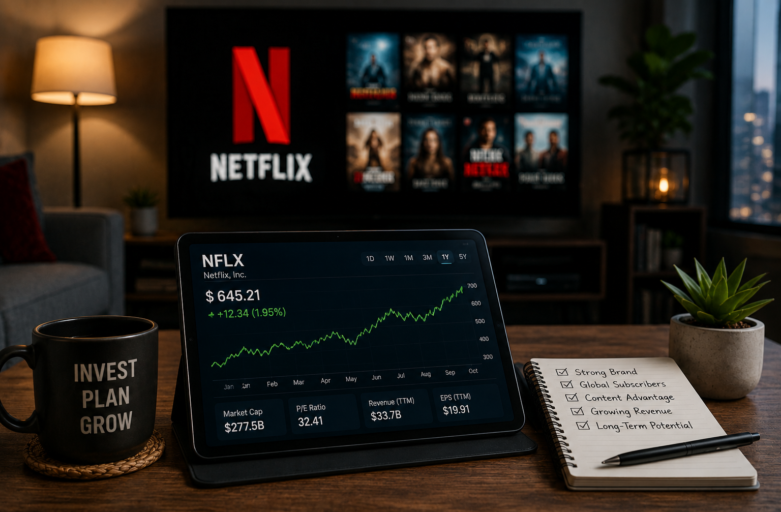

If you’ve caught yourself wondering “Is it too late to invest in Netflix?” you’re not alone. Netflix has been a market favorite for years, but after big price swings, rising competition, and changing viewer habits, many investors are asking whether the streaming giant still offers upside—or if the growth party is over. This post breaks down the key facts, risks, and decision points in plain language so you can decide whether Netflix fits your investment plan.
Where Netflix stands today
Netflix is a leader in streaming with a huge global subscriber base, a deep library of original content, and powerful brand recognition. Its business model is subscription-driven, which gives predictable recurring revenue when subscribers grow and churn stays low. Over the last decade Netflix turned a content-heavy growth play into a mature, profitable company that also invests heavily in original shows and international expansion.
Key metrics investors watch
- Subscribers: Growth in paid memberships shows product-market fit and pricing power. Slower net additions can signal saturation in some markets but opportunity elsewhere (emerging markets, mobile-first users).
- Revenue and ARPU: Total revenue and average revenue per user indicate whether Netflix can monetize its base—important when raising prices or testing ad tiers.
- Profitability & free cash flow: Positive margins and free cash flow mean Netflix can afford content, marketing, debt service, and stock buybacks.
- Content pipeline: Quality and relevance of originals and licensed content drive retention and acquisition.
- Churn rates: Lower churn suggests customers find ongoing value.
- Competition and market share: How Netflix competes with Disney+, Amazon Prime Video, HBO Max (Warner Bros Discovery), regional players, and new entrants affects growth prospects.
Reasons investors worry it might be “too late”
- Slowing subscriber growth in saturated markets: In the U.S. and other mature markets, user growth has decelerated. When core markets mature, companies must look to price increases, ad-supported tiers, or international expansion to grow revenue.
- Intensifying competition: Deep-pocketed competitors (Disney, Amazon, Warner Bros, Apple) and local services in non-U.S. markets make content costs higher and customer choice broader.
- High content costs: Creating hit shows is expensive, and Netflix invests billions annually. If content spend outpaces returns, margins can compress.
- Market expectations: Netflix’s stock often prices in future growth. If growth disappoints or guidance is conservative, the price can drop quickly.
- Macroeconomic and market volatility: Rising interest rates or a market rotation away from growth stocks can hit share prices even if the company’s fundamentals remain solid.
Reasons it may still be a good opportunity
- Global reach and scale advantages: Netflix has distribution in nearly every country, and a large global subscriber base gives content scale and data insights that help optimize spending.
- Proven ability to pivot: Netflix launched ad-supported tiers and password-sharing enforcement, showing it can change strategy to unlock revenue.
- Strong brand and content machine: Hit shows and franchises drive cultural relevance and subscriber loyalty. Successful originals can attract new subscribers for years.
- Growing international opportunities: Many countries still have low streaming penetration; localized content can unlock large new subscriber pools.
- Improved profitability and cash flow: In recent years Netflix shifted focus from sky-high content spending to sustainable free cash flow, appealing to more conservative investors.
- Data-driven content decisions: Netflix uses viewing data to decide what to make and promote, increasing the chances of hits and efficient marketing.
How to evaluate whether to invest now
- Define your investment horizon and goals
- Short-term trader: If you’re trying to time quarterly results or capitalize on momentum, you’ll be sensitive to guidance, subscriber growth reports, and market sentiment.
- Long-term investor: Focus on long-range trends—global streaming adoption, content moat, pricing power, and management execution. Netflix’s long-term story is about subscriber growth and monetization across decades, not just next quarter.
- Assess valuation vs. growth prospects
- Compare price-to-earnings (P/E) and price-to-sales (P/S) ratios to peers and historical averages. A high valuation requires continued strong growth to be justified.
- Look at forward earnings estimates and free cash flow projections. If the current price only makes sense with optimistic growth, consider whether you believe Netflix can deliver.
- Consider business model changes and execution risk
- Ad tiers and password-sharing enforcement are critical tests. If ad revenue ramps up and password sharing declines materially, revenue per user could rise.
- Production quality and hit rate matter. Track new releases, viewership numbers, and cultural buzz to see if Netflix continues to produce engaging content.
- Watch subscriber and ARPU trends in key markets
- Stabilizing or improving ARPU (via price increases and ads) is a positive sign.
- Renewed subscriber growth in international markets is a major upside driver.
- Factor in competitive landscape and content costs
- If competition forces excessive bidding for content, margins may shrink.
- Conversely, if Netflix’s scale gives it better economics (lower per-subscriber content cost), that’s a plus.
- Risk tolerance and portfolio fit
- Growth stocks can be volatile. Decide how much volatility you can handle and whether Netflix fits within your diversification plan (sector balance, exposure to tech/media).
Investment approaches you can use
- Dollar-cost averaging (DCA): Invest a fixed amount at regular intervals regardless of price. This reduces timing risk and smooths out volatility.
- Buy and hold for long-term growth: If you believe in Netflix’s long-term path and can tolerate periods of decline, buy-and-hold may be suitable.
- Value-oriented entry: Wait for price pullbacks or when the market overly discounts Netflix on temporary weakness.
- Partial position with optionality: Take a starter position now and add on dips or as key catalysts (e.g., successful ad rollout, strong international growth) materialize.
- Hedged approach: Use options (protective puts or collars) to limit downside if you’re concerned about near-term volatility.
Key catalysts to watch (could change the thesis)
- Large subscriber additions or stronger-than-expected international growth.
- Successful monetization of ad-supported tier and recovery of ARPU.
- Hit original releases that become durable franchises.
- Clear reduction in content costs per new subscriber.
- Any major partnership (telecom bundling, gaming expansion, or regional content deals).
- Negative catalysts: sustained subscriber losses, ad-rollout troubles, or aggressive price competition from rivals.
Simple checklist before buying
- Do you understand why Netflix can grow revenue over the next 3–5 years?
- Are you comfortable with potential volatility in the near term?
- Is the valuation reasonable given your growth assumptions?
- Have you considered alternatives in the media/tech space?
- Does Netflix fit your risk tolerance and portfolio allocation rules?
Practical example: Two investor profiles
- Conservative long-term investor (moderate risk): Likes the brand, believes in international growth, but worries about valuation. Strategy: DCA over 6–12 months, limit position size to a small percentage of portfolio, and re-evaluate after two earnings seasons.
- Aggressive investor (higher risk tolerance): Believes Netflix will grow ARPU and regain high growth. Strategy: Take a larger initial position, use partial leverage only if comfortable, and actively monitor quarterly subscriber and ARPU updates.
Common investor mistakes to avoid
- Chasing recent price moves: Buying only because the stock is hot can lead to purchases at peaks.
- Ignoring content economics: Focusing only on subscriber counts without checking margins and free cash flow misses the full picture.
- Overlooking competition: Assume competitors will price, bundle, and invest aggressively.
- Not having an exit or rebalancing plan: Know under what conditions you’d sell (valuation, fundamentals deterioration, or outperformance that causes overallocation).
Bottom line answer: Is it too late?
Short answer: Not necessarily.
Long answer: It depends on your goals, timeframe, and conviction in Netflix’s ability to monetize its large global audience and manage content costs. If you’re a long-term investor who believes streaming still has years of growth—especially internationally—and that Netflix can increase ARPU through ads and better enforcement of password sharing, it may still be a compelling buy. If you’re a short-term trader or require low volatility, the stock’s valuation and competitive risks could make it less attractive right now.
Final practical guidance
- If you believe in Netflix’s long-term trajectory, consider dollar-cost averaging to spread entry risk.
- Limit any single stock position to a size that won’t derail your portfolio if the stock falls 30–50%.
- Keep a watchlist of key metrics: global paid net additions, ARPU, churn, content spend, and free cash flow.
- Reassess after 2–4 quarterly earnings reports to see if execution matches expectations.
- Stay diversified: even a strong company can suffer sector-wide downturns or unexpected disruption.