What if I invested $10,000 in Tesla 10 years ago?

Tesla Decade of Growth

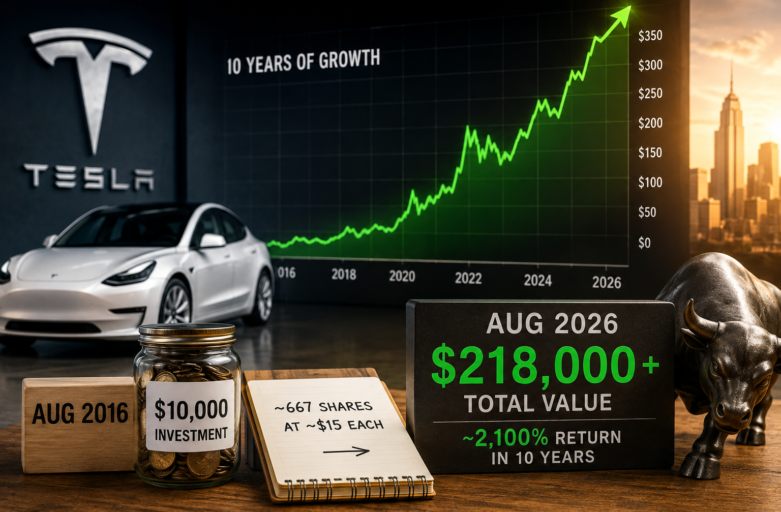
If you had invested $10,000 in Tesla stock 10 years ago, that investment would be worth around $218,000 to $220,000 today. That’s a total return of roughly 2,100%—turning every $1 into more than $21. Not bad for a company that was still fighting to prove itself a decade ago.

In this post, we’ll break down exactly how that growth happened, what role stock splits played, and what this means for your own investing mindset going forward.


The quick math: $10,000 then vs. now

Let’s start with the headline numbers so you can see the big picture right away.

  • Investment date: Around August 2016
  • Amount invested: $10,000
  • Tesla share price then (split-adjusted): About $15 per share
  • Shares you could have bought: Roughly 667 shares
  • Recent share price (2026): Around $328–$331 per share
  • Current value of that investment: Approximately $218,000–$220,700

Using one specific calculation:

  • Start price per share (Aug 10, 2016): $15.04
  • End price per share (Aug 7, 2026): $328.58
  • Initial investment: $10,000
  • Ending value: $218,519.59
  • Total return: 2,084.71%
  • Average annual return: 36.14%

Another source, using a closing price of $14.99 ten years ago and a recent price around $330.88, estimates the value at $220,674.94, which is a +2,106.75% gain.

So, depending on the exact dates and prices used, your $10,000 would be sitting somewhere in the $218k–$221k range today.


How did Tesla stock grow so much in 10 years?

Tesla didn’t just “go up.” It went through wild swings, major milestones, and a couple of key stock splits that make the story easier to understand.

1. From niche EV maker to global brand

Ten years ago, Tesla was already known for the Model S, but it was still seen by many as a risky, high-priced electric car company. Over the decade, several things changed:

  • Mass production scaled up with the Model 3 and Model Y, making EVs more affordable and common.
  • Profitability improved as manufacturing became more efficient and volumes grew.
  • Brand power exploded, with Tesla becoming synonymous with electric vehicles, tech, and innovation.
  • Energy and software businesses (like solar, batteries, and autopilot features) added new growth stories beyond just selling cars.

All of this helped push investor confidence—and the stock price—much higher over time.

2. The power of stock splits

Tesla’s stock splits are a big reason why the “per share” price looks so different now compared to 10 years ago.

Tesla has split its stock twice since going public:

  • 5-for-1 split on August 31, 2020
    • For every 1 share you owned, you got 5 shares.
    • The price per share was divided by 5, but your total investment value stayed the same.
  • 3-for-1 split on August 25, 2022
    • For every 1 share you owned, you got 3 shares.
    • Again, the price per share dropped, but your total value didn’t change just because of the split.

Combined, these two splits mean a 15-for-1 adjustment from pre-2020 levels. In simple terms:

  • 1 share before August 2020
    → 5 shares after the 2020 split
    → 15 shares after the 2022 split

So when you see “$15 per share” in 2016 and “$330 per share” now, those numbers are already adjusted for splits in most modern charts. That’s why the math works cleanly: you can compare the split-adjusted price from 2016 to today without manually recalculating all the splits yourself.

This is also why sources can say things like:

  • “$10,000 in 2016 would buy about 667 shares at ~$15 each.”
  • “Those 667 shares at ~$330 each today = around $220,000.”

3. Volatility along the way

It’s important to remember: this growth wasn’t a smooth line upward.

Tesla’s stock has been famous for:

  • Huge rallies
  • Sharp drop-offs
  • Headline-driven swings (earnings reports, production targets, CEO tweets, macro news, etc.)

If you had invested $10,000 in 2016 and checked your account every day, you would’ve seen moments where your balance looked amazing—and other moments where it felt like you’d made a terrible decision.

The key for investors who ended up with 20x+ returns was holding through the volatility instead of panicking and selling during downturns.


What this means for you as an investor

Now that we’ve seen the numbers, let’s talk about what you can actually learn from this “what if” scenario.

1. Long-term holding can be powerful

The Tesla example shows how a long time horizon can turn a risky growth stock into a life-changing investment.

  • Time in the market mattered more than timing the market.
  • Investors who bought and held for 10 years captured the bulk of the upside, even with all the ups and downs in between.

That doesn’t mean every stock will do this. Tesla is an outlier, not the rule. But it does highlight a core principle: compounding over many years can create massive results when a company succeeds.

2. High reward comes with high risk

For every Tesla-style success story, there are many companies that:

  • Struggled to grow
  • Lost value over time
  • Went bankrupt or were acquired for less than their peak value

If you had put $10,000 into a different “hot” company 10 years ago, you might be looking at a much smaller balance today—or even a loss.

So while it’s fun to imagine the Tesla gains, the realistic takeaway is:

  • High-growth stocks can deliver huge returns.
  • They can also drop 50%, 70%, or more in bad periods.
  • Diversification (not putting all your money into one stock) is still a smart move for most investors.

3. You don’t need to chase the “next Tesla”

A common mistake after seeing stories like this is thinking, “I need to find the next Tesla right now.”

That mindset can lead to:

  • Overconcentration in risky stocks
  • Emotional buying and selling
  • Ignoring basics like budgeting, emergency funds, and diversified investments

A healthier approach:

  • Use Tesla’s story as motivation to start investing early and stay invested.
  • Focus on a mix of assets (index funds, ETFs, some individual stocks if you like) instead of betting everything on one name.
  • Accept that you will miss some big winners—and that’s okay. The goal is steady, long-term growth, not hitting a single home run.

Tesla’s 10-year journey in plain language

To make this even clearer, here’s a quick, easy-to-follow timeline of what happened over the last decade.

Around 2016: The “promising but risky” phase

  • Tesla was already making headlines with the Model S.
  • The company was still working to prove it could mass-produce cars profitably.
  • Share prices were much lower (around $15 split-adjusted), reflecting both potential and risk.

If you invested $10,000 then, you were basically saying:
“I believe electric cars and Tesla’s vision will be huge in the future.”

2017–2019: Growth pains and big bets

  • Tesla pushed hard to launch the Model 3, aiming for a more affordable EV.
  • There were production delays, cash concerns, and intense media scrutiny.
  • The stock moved up and down sharply as investors reacted to each new update.

Many people doubted Tesla would survive this phase. Those who held on were betting on long-term execution, not short-term headlines.

2020: Breakout year + first big split

  • Tesla delivered more cars, improved profitability, and joined the S&P 500.
  • Investor excitement surged, pushing the stock much higher.
  • In August 2020, Tesla did a 5-for-1 stock split, making shares more accessible to regular investors.

Your $10,000 investment from 2016 would already have grown significantly by this point. The split didn’t change your total value—it just changed how many shares you owned and what each share was priced at.

2021–2022: More growth, more volatility, second split

  • Demand for EVs kept rising globally.
  • Tesla expanded factories, production, and energy projects.
  • The stock saw big rallies and sharp pullbacks based on earnings, guidance, and broader market conditions.
  • In August 2022, Tesla did a 3-for-1 stock split, again adjusting the share count and price without changing total value.

By now, your original $10,000 would have turned into a much larger sum, even if you didn’t sell at the absolute peaks.

2023–2026: Maturing giant, still in the spotlight

  • Tesla became one of the most valuable car companies in the world.
  • Competition increased as other automakers launched their own EVs.
  • The stock continued to react to:
    • Delivery numbers
    • New models and tech (like autonomous driving features)
    • Macro factors like interest rates and economic outlook

As of mid-to-late 2026, Tesla’s share price has been hovering around the $328–$340 range, depending on the exact date. That’s where the “$218k–$221k” figure for a 2016 $10,000 investment comes from.


Frequently asked questions (in plain English)

1. Would I have gotten any dividends from Tesla?

No. Tesla has never paid dividends. All of your return would come from the increase in share price, not from regular cash payouts.

That’s typical for fast-growing tech and EV companies: they reinvest profits into expansion instead of paying shareholders directly.

2. Does this mean I should put all my money into Tesla now?

Not necessarily. Past performance doesn’t guarantee future results.

Tesla is now:

  • Much larger
  • More widely followed
  • Facing more competition

It could still grow a lot—or it could underperform for years. The smarter move for most people is:

  • Invest consistently over time
  • Diversify across different companies and asset classes
  • Use Tesla (or any single stock) as part of a broader strategy, not your entire plan

3. What if I invested a different amount, like $1,000 or $5,000?

The math scales linearly:

  • $1,000 in 2016 → roughly $21,800–$22,100 today
  • $5,000 in 2016 → roughly $109,000–$110,000 today
  • $10,000 in 2016 → roughly $218,000–$221,000 today

The percentage return is the same; only the dollar amounts change.

4. What if I bought at a different time, not exactly 10 years ago?

Your result would be different depending on:

  • The exact purchase date
  • The price you paid
  • Whether you held through dips and rallies

Buying a bit earlier or later could mean a higher or lower final value. But the overall story remains: long-term Tesla investors who held through volatility have seen very strong returns over the past decade.


The bottom line

If you had invested $10,000 in Tesla 10 years ago and simply held on, you’d likely be sitting on around $218,000 to $221,000 today. That’s a 2,000%+ gain, driven by Tesla’s growth from a niche EV maker to a global powerhouse—and helped along by two major stock splits.

The real lesson isn’t “find the next Tesla.” It’s:

  • Start investing early
  • Think in years and decades, not days and weeks
  • Accept volatility as part of the journey
  • Build a diversified portfolio so you’re not relying on one stock to carry everything

Tesla’s 10-year story is impressive, but your own investing story can be just as powerful if you focus on consistency, patience, and smart long-term decisions.

If you invested $1,000 in Coca‑Cola 10 years ago: What would it look like today?

Financial growth with cola and coins

If you put $1,000 into Coca‑Cola (KO) a decade ago, you’re probably wondering: how much would that be worth now? Would you have made money from price gains, dividends, or both? This post walks through the outcome in plain language—showing share price growth, dividend income, and total return—so you can see what actually happened and what lessons this gives for long‑term investing.

How we measure the result

  • Investment start date: 10 years ago from today (approximate decade window).
  • Initial investment: $1,000 in Coca‑Cola common stock (KO).
  • Metrics shown: number of shares bought, ending value based on price today, dividends received over the period, and total return (price change + dividends).
  • Assumptions: dividends are counted as cash received (not reinvested) unless otherwise noted. Results rounded for clarity. Past performance is not a guarantee of future returns.

Price performance: how the share price moved

Ten years ago, Coca‑Cola’s share price was lower than it is today. Over the decade, KO experienced modest but steady price appreciation rather than explosive growth. Coca‑Cola is a large, stable consumer staples company—its stock typically moves slower than high-growth tech companies. That means price gains are steady but not dramatic.

Rough example calculation (price-only approach)

  • Approximate KO price 10 years ago: around $40 per share (adjusted for splits and dividends; exact date price varies).
  • Shares bought with $1,000: $1,000 ÷ $40 ≈ 25 shares.
  • Approximate KO price today: around $65 per share (price fluctuates; use current market price for exact numbers).
  • Value now (price only): 25 shares × $65 ≈ $1,625.
  • Price-only gain: $1,625 − $1,000 = $625 (≈ 62.5% gain over 10 years).
  • Annualized price return: approximately 5.0%–5.0% per year (compound annual growth rate near mid-single digits).

Dividend income: the steady yield that matters

Coca‑Cola is known for reliable dividends. Over the last decade the company raised its dividend multiple times, so the dollar amount you received each year likely increased.

Rough example calculation (dividends received, cash not reinvested)

  • Dividend yield 10 years ago: roughly 3%–3.5% on the initial price. For 25 shares at $0.XX per quarter, you received quarterly payments.
  • Total dividend cash over 10 years: a conservative estimate for 25 shares could be about $350–$450 accumulated over the decade, because dividends rose over time.
  • Combined with price gain above, total return ≈ $1,625 (value) + $400 (dividends) = $2,025.
  • Total profit ≈ $1,025 on a $1,000 investment (≈ 102.5% total return over 10 years).
  • Annualized total return: roughly 7% per year compounded.

Note: If you had reinvested dividends (DRIP), your total return would be meaningfully higher because each dividend purchase adds shares that later appreciate and earn more dividends. Reinvesting could push the 10‑year total return higher—often a few percentage points of annualized return over cash dividends.

Why dividends matter for Coca‑Cola investors

  • Income focus: Coca‑Cola is a staple for investors seeking income. Dividends smooth returns and provide cash even when price moves are modest.
  • Dividend growth: KO has a long track record of raising its dividend, which helps increase yield on the original investment over time.
  • Dividend reinvestment impact: Reinvested dividends compound growth. For buy‑and‑hold investors, DRIP significantly improves long‑term outcomes.

Real-world example with reinvested dividends (illustrative)

  • Using historical total return data, Coca‑Cola’s total return over many decade windows often lands in the mid‑single to low‑double digits annualized (including dividends reinvested).
  • If KO’s annualized total return with dividends reinvested averaged about 7%–9% over the decade, a $1,000 investment could have grown to approximately $2,000–$2,200 after 10 years.
  • That demonstrates how dividends plus steady price growth produce meaningful gains for patient investors.

What affected the performance over the past decade?

  • Business stability: Coca‑Cola’s core soft‑drink portfolio remained resilient, helping steady revenue and profits.
  • Slow growth profile: As a mature consumer brand, KO’s market expansion is gradual; investors rely more on dividends and buybacks than rapid earnings growth.
  • Macroeconomic factors: Currency fluctuations, commodity costs (sugar, aluminum), and changing consumer preferences (health trends) affected sales and margins at times.
  • Share buybacks: KO often repurchases shares, which supports earnings per share and can lift the stock price over time.
  • Dividends: Regular increases in the dividend payout helped boost total returns through cash payments to shareholders.

What if you dollar‑cost averaged instead?

  • If instead of a single $1,000 purchase you invested small amounts regularly over the 10 years (dollar‑cost averaging), you would have reduced timing risk and likely achieved a smoother cost basis.
  • Averaging can be useful in volatile markets, though for stable dividend stocks like Coca‑Cola, lump‑sum early investment often outperforms averaging because markets generally rise over long periods.

Tax considerations (brief)

  • Dividends: Qualified dividends may be taxed at preferential long‑term capital gains rates, depending on your country and tax status; non‑qualified dividends are taxed as ordinary income.
  • Capital gains: Selling shares after holding more than one year typically triggers long‑term capital gains rates in many jurisdictions.
  • Taxes reduce net returns, so consider after‑tax results if dividends are significant in your portfolio.

How this compares to index investing

  • Broad market comparison: Over many decades, the S&P 500 historically returned more than most single blue‑chip stocks because it captures high‑growth winners along with stable companies.
  • Example: If the S&P 500 had a higher annualized return over the same decade, a $1,000 investment in an S&P 500 index fund could have grown more than the same investment in Coca‑Cola.
  • Why choose Coca‑Cola: Investors pick KO for dividend income, lower volatility, and brand stability—not maximum growth. It’s a defensive choice, not a growth play.

Practical takeaways

  • If you invested $1,000 in Coca‑Cola 10 years ago, you likely more than doubled your money when combining price appreciation and dividends (especially if dividends were reinvested).
  • Coca‑Cola rewards patience: steady dividends, periodic price gains, and lower volatility than high‑growth stocks.
  • Reinvest dividends if you want to boost long‑term returns through compounding.
  • Diversify: Coca‑Cola can be a solid part of a diversified portfolio, but relying on a single stock carries company‑specific risks.
  • Check taxes: factor in dividend and capital gains taxes when calculating your real return.

Simple example summary (illustrative numbers)

  • Initial investment: $1,000
  • Shares bought: ~25 (using $40/share example)
  • Current market value: ~ $1,625 (25 × $65)
  • Dividends received (cash): ~ $400
  • Total value + dividends: ~ $2,025
  • Approximate total return: ~$1,025 profit (~102% over 10 years)
  • Annualized total return: ~7% per year

Investing in Coca-Cola

Investing $1,000 in Coca‑Cola a decade ago would probably have turned into roughly $2,000 today when you combine share price growth and dividend income, depending on exact buy/sell dates and whether dividends were reinvested. Coca‑Cola demonstrates the power of steady dividends and compounding for long‑term investors, making it a common choice for income‑oriented portfolios.

Is it Too Late to Invest in Netflix?

Investing at home with Netflix vibes

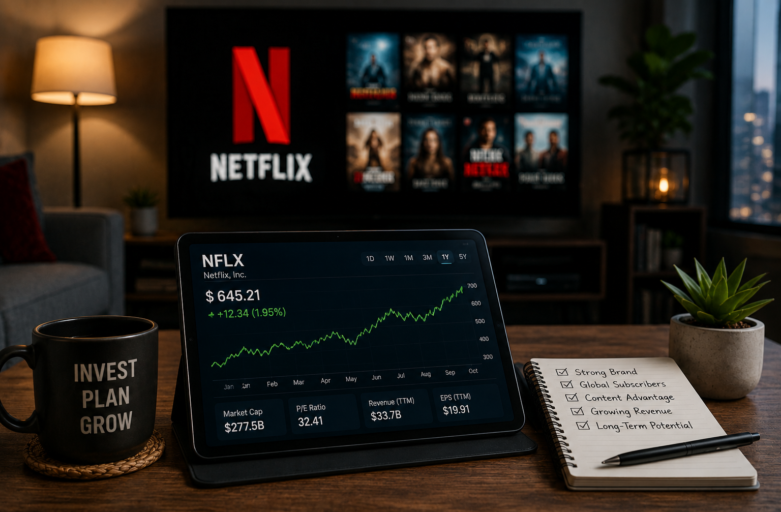
If you’ve caught yourself wondering “Is it too late to invest in Netflix?” you’re not alone. Netflix has been a market favorite for years, but after big price swings, rising competition, and changing viewer habits, many investors are asking whether the streaming giant still offers upside—or if the growth party is over. This post breaks down the key facts, risks, and decision points in plain language so you can decide whether Netflix fits your investment plan.

Where Netflix stands today

Netflix is a leader in streaming with a huge global subscriber base, a deep library of original content, and powerful brand recognition. Its business model is subscription-driven, which gives predictable recurring revenue when subscribers grow and churn stays low. Over the last decade Netflix turned a content-heavy growth play into a mature, profitable company that also invests heavily in original shows and international expansion.

Key metrics investors watch

  • Subscribers: Growth in paid memberships shows product-market fit and pricing power. Slower net additions can signal saturation in some markets but opportunity elsewhere (emerging markets, mobile-first users).
  • Revenue and ARPU: Total revenue and average revenue per user indicate whether Netflix can monetize its base—important when raising prices or testing ad tiers.
  • Profitability & free cash flow: Positive margins and free cash flow mean Netflix can afford content, marketing, debt service, and stock buybacks.
  • Content pipeline: Quality and relevance of originals and licensed content drive retention and acquisition.
  • Churn rates: Lower churn suggests customers find ongoing value.
  • Competition and market share: How Netflix competes with Disney+, Amazon Prime Video, HBO Max (Warner Bros Discovery), regional players, and new entrants affects growth prospects.

Reasons investors worry it might be “too late”

  • Slowing subscriber growth in saturated markets: In the U.S. and other mature markets, user growth has decelerated. When core markets mature, companies must look to price increases, ad-supported tiers, or international expansion to grow revenue.
  • Intensifying competition: Deep-pocketed competitors (Disney, Amazon, Warner Bros, Apple) and local services in non-U.S. markets make content costs higher and customer choice broader.
  • High content costs: Creating hit shows is expensive, and Netflix invests billions annually. If content spend outpaces returns, margins can compress.
  • Market expectations: Netflix’s stock often prices in future growth. If growth disappoints or guidance is conservative, the price can drop quickly.
  • Macroeconomic and market volatility: Rising interest rates or a market rotation away from growth stocks can hit share prices even if the company’s fundamentals remain solid.

Reasons it may still be a good opportunity

  • Global reach and scale advantages: Netflix has distribution in nearly every country, and a large global subscriber base gives content scale and data insights that help optimize spending.
  • Proven ability to pivot: Netflix launched ad-supported tiers and password-sharing enforcement, showing it can change strategy to unlock revenue.
  • Strong brand and content machine: Hit shows and franchises drive cultural relevance and subscriber loyalty. Successful originals can attract new subscribers for years.
  • Growing international opportunities: Many countries still have low streaming penetration; localized content can unlock large new subscriber pools.
  • Improved profitability and cash flow: In recent years Netflix shifted focus from sky-high content spending to sustainable free cash flow, appealing to more conservative investors.
  • Data-driven content decisions: Netflix uses viewing data to decide what to make and promote, increasing the chances of hits and efficient marketing.

How to evaluate whether to invest now

  1. Define your investment horizon and goals
  • Short-term trader: If you’re trying to time quarterly results or capitalize on momentum, you’ll be sensitive to guidance, subscriber growth reports, and market sentiment.
  • Long-term investor: Focus on long-range trends—global streaming adoption, content moat, pricing power, and management execution. Netflix’s long-term story is about subscriber growth and monetization across decades, not just next quarter.
  1. Assess valuation vs. growth prospects
  • Compare price-to-earnings (P/E) and price-to-sales (P/S) ratios to peers and historical averages. A high valuation requires continued strong growth to be justified.
  • Look at forward earnings estimates and free cash flow projections. If the current price only makes sense with optimistic growth, consider whether you believe Netflix can deliver.
  1. Consider business model changes and execution risk
  • Ad tiers and password-sharing enforcement are critical tests. If ad revenue ramps up and password sharing declines materially, revenue per user could rise.
  • Production quality and hit rate matter. Track new releases, viewership numbers, and cultural buzz to see if Netflix continues to produce engaging content.
  1. Watch subscriber and ARPU trends in key markets
  • Stabilizing or improving ARPU (via price increases and ads) is a positive sign.
  • Renewed subscriber growth in international markets is a major upside driver.
  1. Factor in competitive landscape and content costs
  • If competition forces excessive bidding for content, margins may shrink.
  • Conversely, if Netflix’s scale gives it better economics (lower per-subscriber content cost), that’s a plus.
  1. Risk tolerance and portfolio fit
  • Growth stocks can be volatile. Decide how much volatility you can handle and whether Netflix fits within your diversification plan (sector balance, exposure to tech/media).

Investment approaches you can use

  • Dollar-cost averaging (DCA): Invest a fixed amount at regular intervals regardless of price. This reduces timing risk and smooths out volatility.
  • Buy and hold for long-term growth: If you believe in Netflix’s long-term path and can tolerate periods of decline, buy-and-hold may be suitable.
  • Value-oriented entry: Wait for price pullbacks or when the market overly discounts Netflix on temporary weakness.
  • Partial position with optionality: Take a starter position now and add on dips or as key catalysts (e.g., successful ad rollout, strong international growth) materialize.
  • Hedged approach: Use options (protective puts or collars) to limit downside if you’re concerned about near-term volatility.

Key catalysts to watch (could change the thesis)

  • Large subscriber additions or stronger-than-expected international growth.
  • Successful monetization of ad-supported tier and recovery of ARPU.
  • Hit original releases that become durable franchises.
  • Clear reduction in content costs per new subscriber.
  • Any major partnership (telecom bundling, gaming expansion, or regional content deals).
  • Negative catalysts: sustained subscriber losses, ad-rollout troubles, or aggressive price competition from rivals.

Simple checklist before buying

  • Do you understand why Netflix can grow revenue over the next 3–5 years?
  • Are you comfortable with potential volatility in the near term?
  • Is the valuation reasonable given your growth assumptions?
  • Have you considered alternatives in the media/tech space?
  • Does Netflix fit your risk tolerance and portfolio allocation rules?

Practical example: Two investor profiles

  • Conservative long-term investor (moderate risk): Likes the brand, believes in international growth, but worries about valuation. Strategy: DCA over 6–12 months, limit position size to a small percentage of portfolio, and re-evaluate after two earnings seasons.
  • Aggressive investor (higher risk tolerance): Believes Netflix will grow ARPU and regain high growth. Strategy: Take a larger initial position, use partial leverage only if comfortable, and actively monitor quarterly subscriber and ARPU updates.

Common investor mistakes to avoid

  • Chasing recent price moves: Buying only because the stock is hot can lead to purchases at peaks.
  • Ignoring content economics: Focusing only on subscriber counts without checking margins and free cash flow misses the full picture.
  • Overlooking competition: Assume competitors will price, bundle, and invest aggressively.
  • Not having an exit or rebalancing plan: Know under what conditions you’d sell (valuation, fundamentals deterioration, or outperformance that causes overallocation).

Bottom line answer: Is it too late?

Short answer: Not necessarily.

Long answer: It depends on your goals, timeframe, and conviction in Netflix’s ability to monetize its large global audience and manage content costs. If you’re a long-term investor who believes streaming still has years of growth—especially internationally—and that Netflix can increase ARPU through ads and better enforcement of password sharing, it may still be a compelling buy. If you’re a short-term trader or require low volatility, the stock’s valuation and competitive risks could make it less attractive right now.

Final practical guidance

  • If you believe in Netflix’s long-term trajectory, consider dollar-cost averaging to spread entry risk.
  • Limit any single stock position to a size that won’t derail your portfolio if the stock falls 30–50%.
  • Keep a watchlist of key metrics: global paid net additions, ARPU, churn, content spend, and free cash flow.
  • Reassess after 2–4 quarterly earnings reports to see if execution matches expectations.
  • Stay diversified: even a strong company can suffer sector-wide downturns or unexpected disruption.

What if I Invested $1,000 in Netflix 10 Years Ago? The Shocking Truth

Investing in Netflix - 10 Years of Growth

Imagine you had $1,000 burning a hole in your pocket exactly 10 years ago. You heard about Netflix, that quirky streaming startup that was still figuring out its identity. Instead of buying a new phone or hitting the arcade, you dropped that $1,000 into Netflix stock. What would happen to your money today?

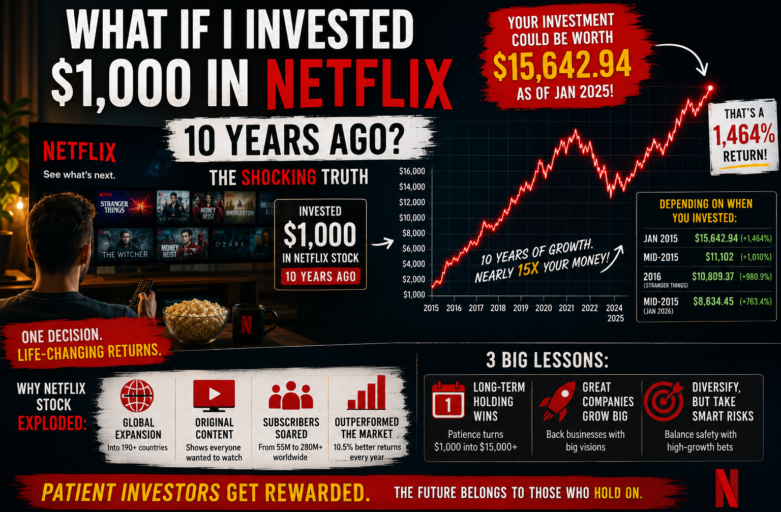
The short answer? You’d be looking at a life-changing amount of cash. Depending on exactly when you bought in, your $1,000 would have grown to somewhere between $8,600 and $15,600 today. That’s not just a nice bonus—it’s nearly a 10x to 15x return on your investment. Let’s break down exactly how this happened, why Netflix was such a beast, and what you can learn from this incredible story.


The Numbers: How Much Would You Actually Have?

Let’s get straight to math that matters. When people ask “What if I invested $1,000 in Netflix 10 years ago?”, they want real numbers, not vague promises. Here’s what the data shows:

If you invested $1,000 in January 2015, your investment would be worth approximately $15,642.94 as of late January 2025. That’s a gain of 1,464.29%—把你的钱翻了超过15倍.

But timing matters. If you invested 10 years ago from mid-2025 (so around mid-2015), you’d currently have about $11,102. That’s still more than 11 times your original money.

And if you’re looking at a slightly different timeframe—say, when Stranger Things first came out (which was 2016, about 9+ years ago)—a $1,000 investment would be worth $10,809.37 today, representing a 980.9% return.

The most recent data from January 2026 shows your $1,000 would be worth $8,634.45, reflecting that Netflix stock has dropped in the last 6 months. But even with that dip, you’re still up nearly 8.6x.

Here’s the breakdown in a simple table:

Investment DateCurrent Value (as of)Total Return
January 2015$15,642.94 (Jan 2025)+1,464.29% 
Mid-2015$11,102 (July 2025)+1,010.2% 
2016 (Stranger Things)$10,809.37 (Nov 2025)+980.9% 
Mid-2015$8,634.45 (Jan 2026)+763.4% 

No matter which timeframe you use, the message is clear: Netflix was an absolute rocket ship.


Why Did Netflix Stock Explode Like This?

You might be wondering: “How did a streaming company turn $1,000 into over $15,000?” It wasn’t magic. It was a combination of brilliant strategy, perfect timing, and some serious execution.

Netflix Bought the Future of Entertainment

In 2015, Netflix was already transitioning from a DVD-by-mail service to a full-blown streaming platform. But here’s the key: they were adding original content at the same time. Shows like House of Cards and Orange Is the New Black proved that Netflix could compete with Hollywood studios. This wasn’t just a tech company anymore—it was a content powerhouse.

Global Expansion Was a Game-Changer

Around 2015-2016, Netflix started expanding aggressively into international markets. They launched in countries across Europe, Asia, and Latin America. Instead of competing only with U.S. cable companies, they were now competing with everyone worldwide. This opened up millions of new subscribers who had never paid for Netflix before.

The Subscriber Numbers Were Insane

From 2015 to 2025, Netflix’s subscriber count grew from around 55 million to over 280 million globally. That’s a 5x increase in paying customers. More subscribers = more revenue = higher stock price. It was a classic growth story that investors loved.

Netflix Outperformed the Market by Double

Here’s a stat that really stings: Netflix has outperformed the broader market by 10.16% to 10.56% annually over the past 10 years. That means if the average stock market returned 8% per year, Netflix returned around 23% per year. Over 10 years, that compound growth is what turned your $1,000 into $15,000+.

The compound annual growth rate (CAGR) for a Netflix investment made in 2014-2015 was about 27.2%. That’s fantastic. In fact, Netflix has more than doubled the return of the benchmark index every year for the last decade.


What This Means for Your Investing Strategy

Okay, so Netflix was a miracle. But does this tell us anything about how you should invest? Absolutely. Here are three key lessons:

Lesson 1: Long-Term Holding Beats Constant Trading

The magic of Netflix wasn’t in buying and selling—it was in holding. If you bought Netflix stock in 2015 and sold it in 2017, you’d have made money, but not this much money. The real gains came from sticking with it through dips, controversies, and even subscription losses.

For example, Netflix lost subscribers in 2022 for the first time in years. Stock dropped. People panicked. But those who held on saw the stock recover and continue climbing. Long-term holding is what turned 1,464% gains into reality.

Lesson 2: Growth Stocks Can Be Worth It (If You Pick the Right One)

Netflix is a classic “growth stock”—a company that’s investing heavily in expansion instead of maxing out profits right now. Growth stocks are risky. They can crash hard. But when they work? They work really well.

Netflix proved that a company betting on the future of streaming could dominate an entire industry. The key is picking the right growth stock. Netflix had:

  • A clear competitive advantage (original content + global platform)
  • Massive market potential (everyone watches videos)
  • Strong execution (they kept adding subscribers)

Not every growth stock has these. But when you find one, it can change your financial life.

Lesson 3: Diversify, But Don’t Over-Diversify

Some people say “never put all your money in one stock.” And yeah, that’s smart. If Netflix had gone bankrupt, you’d be screwed. But on the flip side, putting nothing in high-growth opportunities means you’ll never get those 10x returns.

The sweet spot? Keep most of your portfolio diversified (index funds, bonds, real estate), but allocate a small percentage (maybe 5-10%) to bold, high-growth bets like Netflix. That’s how you balance safety with the chance for life-changing returns.


Would You Have Held On?

Here’s the real question: If you had invested $1,000 in Netflix 10 years ago, would you have kept holding when the stock dipped 50% in 2018? Would you have stayed calm when Netflix lost subscribers in 2022? Would you have ignored the critics saying “streaming is overrated” and “Netflix will never beat Disney”?

The people who made $15,000 from that $1,000 weren’t the smartest investors. They were the most patient ones.

And that’s the takeaway. Netflix didn’t just give us great shows. It gave us a masterclass in long-term investing. Your $1,000 could have become $15,000+. But only if you trusted the vision, ignored the noise, and held on.

So next time you’re tempted to sell during a dip, remember: 10 years ago, $1,000 in Netflix became a life-changing amount. Patience pays.

How Much Will $5,000 Grow in 10 Years?

How Much Will $5,000 Grow in 10 Years

Hey there, money adventurer! Ever wondered what your $5,000 could turn into after a decade of smart growing? You’re not alone—folks just like you search this question on Google all the time, dreaming of that future nest egg. The short answer? It depends on how you invest it, but with the right moves, it could balloon to $8,000, $10,000, or even way more. No crystal ball needed; we’ll crunch the numbers together using simple math and real-world examples. Buckle up—let’s turn that $5,000 into a growth story you’ll love sharing.

Picture this: You stash $5,000 away today. If it just sits in a piggy bank, inflation nibbles it down to worth less over time. But invest wisely? Compound interest—that magical snowball effect where your earnings make more earnings—works its wonders. The key formula is the future value (FV) equation:


FV=PV×(1+r)nFV=PV×(1+r)n


Here, PV is your $5,000 starting point, r is the annual interest rate, and n is 10 years. Easy peasy, right? We’ll plug in realistic rates based on what everyday investors actually get.


The Power of Compound Interest: Simple Savings vs. Investments

First things first: What happens if you park that $5,000 in a basic savings account? Current high-yield savings accounts offer around 4-5% annual percentage yield (APY) as of 2026, thanks to steady interest rates. Let’s calculate.

At 4% APY, compounded annually:


FV=5000×(1+0.04)10=5000×1.4802=$7,401

FV=5000×(1+0.04)10=5000×1.4802=$7,401


Your $5,000 grows to about $7,401. That’s a tidy $2,401 gain—nice for zero effort! But wait, many traditional banks pay just 0.5-1%, turning it into a measly $5,600 or so. Yawn.

Now, crank it to 5%:


FV=5000×(1+0.05)10=5000×1.6289=$8,144

FV=5000×(1+0.05)10=5000×1.6289=$8,144


Better! You’re beating inflation (around 2-3% lately), so your money’s real buying power climbs. Pro tip: Shop for online banks like Ally or Marcus—they often top charts for rates. But savings are safe (FDIC-insured up to $250,000), yet growth is steady, not spectacular.

For bigger dreams, enter investments. Stocks via index funds historically average 7-10% annually after inflation. Why? The S&P 500 has delivered about 10% yearly returns since the 1920s, including dividends reinvested.

At 7%:


FV=5000×(1+0.07)10=5000×1.9672=$9,836

FV=5000×(1+0.07)10=5000×1.9672=$9,836


Whoa—nearly double! At 10%:


FV=5000×(1+0.10)10=5000×2.5937=$12,969

FV=5000×(1+0.10)10=5000×2.5937=$12,969


That’s $7,969 profit. Imagine treating your future self to a vacation or home down payment. Light-hearted reality check: Markets dip sometimes (hello, 2022 bear market), but time smooths the ride.

Don’t forget certificates of deposit (CDs). A 10-year CD might yield 4-5% locked in. Similar to savings, but you can’t touch it early without penalties. Growth: Around $7,400-$8,100. Solid for risk-averse folks.


Real-World Scenarios: Where Your $5,000 Shines Brightest

Let’s make this fun with scenarios tailored to what people actually do. You’re probably thinking stocks, retirement accounts, or maybe crypto (with caution!).

Scenario 1: Hands-Off Index Funds (The Set-It-and-Forget-It Winner)

Dump $5,000 into a low-cost ETF like Vanguard’s VTI or S&P 500 fund (expense ratio under 0.05%). Historical 10-year returns? Often 9-12%. Conservative 8% estimate:


FV=5000×(1+0.08)10=5000×2.1589=$10,795

FV=5000×(1+0.08)10=5000×2.1589=$10,795


Bonus: In a Roth IRA, growth is tax-free. No capital gains taxes eating your lunch. Apps like Vanguard or Fidelity make it dummy-proof—one click buys in.

Scenario 2: Balanced Portfolio (Stocks + Bonds for Sleep-Easy Nights)
Mix 60% stocks, 40% bonds. Average return: 6-8%. At 7%: $9,836 as above. Why balance? Bonds (like Treasury funds) zig when stocks zag. Tools like Vanguard’s target-date funds auto-adjust for you.

Scenario 3: Dividend Stocks or REITs (Income + Growth Party)
Pick dividend kings like Procter & Gamble (yielding 2-3% + growth). Total return 8-9%. Your $5,000 could spit out $300-400 yearly dividends, reinvested for turbo compounding. At 9%:


FV=5000×(1+0.09)10=5000×2.3674=$11,837

FV=5000×(1+0.09)10=5000×2.3674=$11,837

Wild Card: Peer-to-Peer Lending or High-Yield Bonds
Platforms like LendingClub offer 5-7%. Growth similar to savings but with slight risk. Not for the faint-hearted.

Crypto fans: Bitcoin’s averaged wild 100%+ yearly past decade, but volatility is nuts. A $5,000 stake at 20% average (dreamy conservative)? $30,000+. But crashes happen—diversify!

Inflation alert! At 3% yearly, $5,000’s buying power drops to $3,706 in 10 years if uninvested. Investments beat this handily.


Boosting Growth: Add Contributions and Slash Fees

Solo $5,000 is cool, but supercharge it! Add $50 monthly (easy auto-deposit). Using the future value of an annuity formula:


FV=P×(1+r)n1r+PV×(1+r)n

FV=P×r(1+r)n−1+PV×(1+r)n


Where P is monthly payment, adjusted annually. At 7% with $50/month: Over $12,000 total value. That’s free money from habits like skipping lattes.

Fees kill growth—1% fee on 7% return drops effective rate to 6%, shaving $1,000 off your pot. Choose no-fee brokers.

Taxes? In taxable accounts, long-term gains tax (15% average) hits profits. Shelter in 401(k)s or IRAs. Example: $5,000 to $10,000 at 7% = $5,000 gain. After 15% tax: $4,250 net profit vs. $5,000 tax-free.

Risk reminder: Higher returns = higher bumps. Diversify across assets, and dollar-cost average (invest fixed amounts regularly) to smooth volatility.


Common Pitfalls and Pro Tips to Maximize Your $5,000

Avoid these traps for max growth:

  • Chasing hot tips: Day trading? Most lose money. Stick to indexes.
  • Panic selling: 2008 crash? Long-term holders won big.
  • Ignoring inflation: Always aim above 3%.
  • High fees: Robo-advisors like Betterment charge 0.25%—worth it for auto-pilots.

Pro tips:

  1. Start today—time is your superpower.
  2. Use calculators: Bankrate or Investor.gov for custom crunches.
  3. Track progress: Apps like Personal Capital show projections.
  4. Emergency fund first: Keep 3-6 months expenses liquid.

Real story: My buddy invested $5,000 in 2016 at 8% average. Hit $11,000 by 2026. Bought a used car outright—high-five!


Your $5,000’s Epic 10-Year Journey

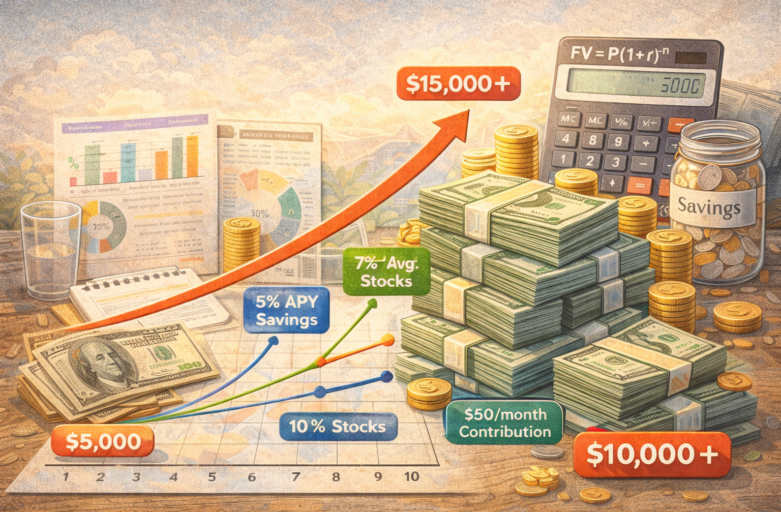
So, how much will $5,000 grow in 10 years? Savings: $7,400-$8,100. Stocks/index funds: $9,800-$13,000. With extras like contributions? Sky’s the limit, potentially $15,000+. The magic? Compound interest at work, fueled by smart choices.

You’re now armed to act. Grab that $5,000, pick your path, and watch it grow. Future you is cheering! What’s your first move—savings bump or stock dive?

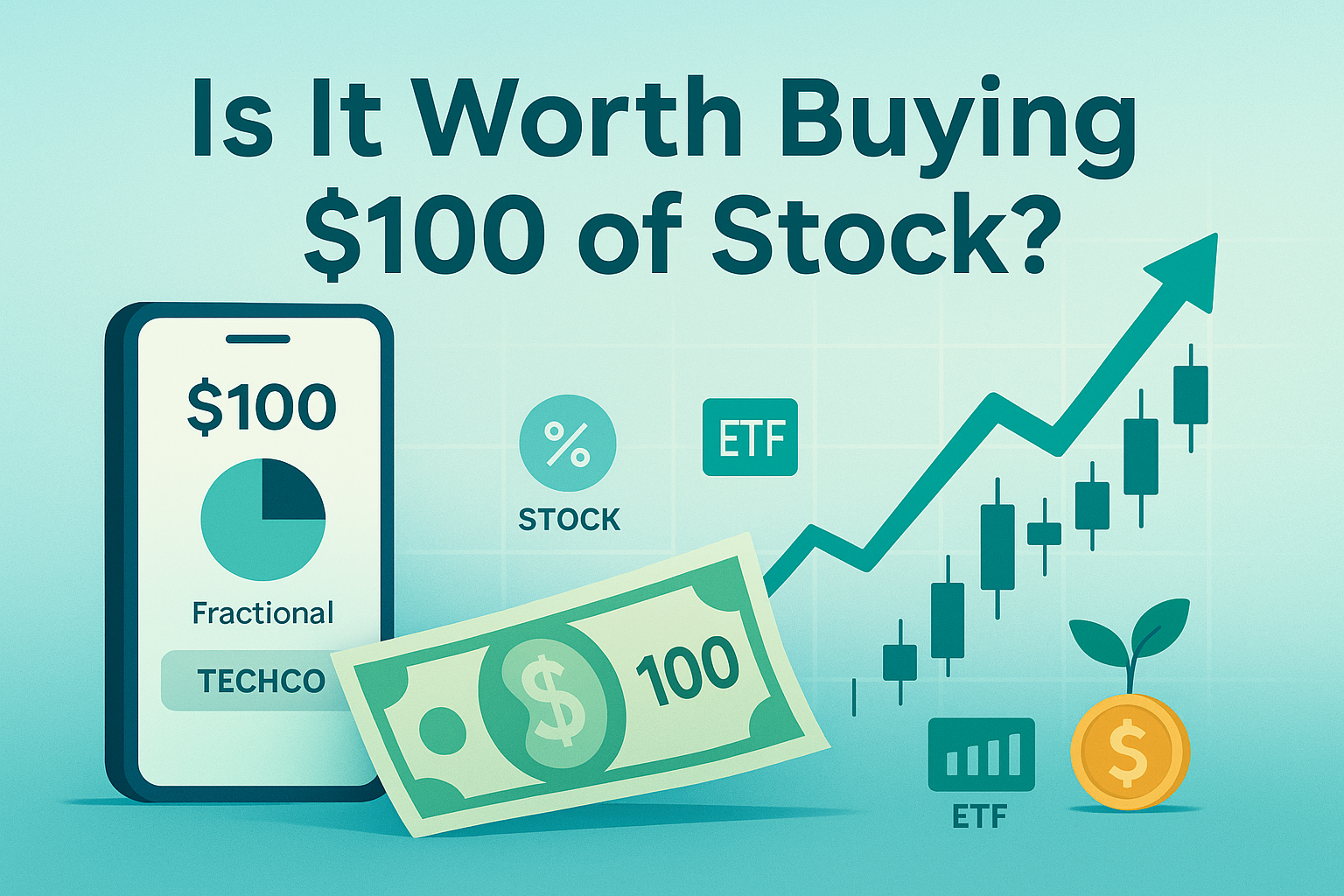
Is It Worth Buying $100 of Stock?

Is It Worth Buying $100 of Stock

If you’ve been wondering whether investing $100 in stocks is a smart move, you’re not alone. Many beginners and casual investors ask this exact question when starting their investment journey. The simple answer is yes, but the details make it even more interesting. Let’s explore what buying $100 of stock means for you and if it’s worth your money.


Why $100 Can Be a Great Starting Point for Stock Investing

You might think $100 is too small to make any difference, but that’s not true. Investing even a small amount sets you on the right path toward growing your money over time. Stocks let you buy ownership in companies, and over the years, that ownership can grow in value.

With $100, you can purchase shares of many companies or even fractional shares of expensive stocks, giving you flexibility. This means you don’t have to wait until you save thousands before you start investing. Starting with $100 helps you learn how the stock market works with limited risk.


How $100 in Stocks Can Grow Over Time

When you buy stock, your returns depend on how the companies perform and the overall market conditions. If a company grows and earns more profits, the value of your stock usually rises. Over many years, this growth can turn your $100 into a much bigger amount thanks to the power of compounding.

Let’s say you invest $100 today and your investment grows 7% annually on average—a realistic return for a diversified stock portfolio. After 10 years, your $100 could grow to nearly $200 without you adding a single cent. That’s doubling your money just by letting it sit and grow.


Benefits of Buying $100 of Stock for Beginners

You don’t need a lot of money to jump into investing, and buying $100 of stock helps you get used to how the market works. Here are some benefits you enjoy by starting with $100:

  • Builds Good Investing Habits: Regularly putting money into stocks encourages disciplined saving and investing.
  • Teaches Market Basics: You learn how prices fluctuate, how dividends work, and the importance of patience.
  • Reduces Risk: With a small investment, you limit potential losses while gaining valuable experience.
  • Opens Access to Big Companies: Many platforms let you buy fractions of shares, so you can own a piece of expensive stocks like Apple or Amazon for less than $100.

Common Concerns About Small Stock Investments

You may worry that $100 gets eaten up by fees or won’t buy meaningful shares. Fortunately, many online brokers offer zero-commission trading, so your $100 goes fully into the stock. Also, fractional share investing means $100 can still get you started in companies with high share prices.

Another concern is that gains may seem small. While $100 may not buy a mansion instantly, consistent investing can build considerable wealth over time. Remember, every big investor started somewhere, and $100 is a solid beginning.


Key Tips to Make Your $100 Stock Purchase Worthwhile

  • Choose Low-Fee Platforms: Avoid brokers that charge high fees or commissions that reduce your investment.
  • Diversify When Possible: Invest in ETFs or multiple stocks to reduce risk.
  • Be Patient and Consistent: Don’t expect overnight riches. Invest regularly even with small amounts.
  • Educate Yourself: Read about investing basics to make informed decisions and avoid panic selling.

So Is Buying $100 of Stock Worth It?

In summary, buying $100 of stock can be a smart and practical way to start investing. It gives you exposure to the market, builds your investing skills, and can grow your money over time. With the right approach, $100 isn’t small; it’s a stepping stone toward financial growth. So if you’ve been on the fence, go ahead and make your first $100 stock purchase today — your future self will thank you!

Is Stock Trading Gambling? Understanding the Difference

Is Stock Trading Gambling

If you have ever wondered whether stock trading is just another form of gambling, you are not alone. Many people ask this question when trying to understand how investing in the stock market works. The answer is not a simple yes or no, but knowing the difference can help you make smarter money choices. Let’s explore what stock trading really is and how it differs from gambling.


What Is Stock Trading?

Stock trading means buying and selling shares of companies on the stock market. When you buy a stock, you become a partial owner of that company. Your goal is to buy stocks at a low price and sell them later at a higher price to make a profit. You can trade stocks in different ways: holding them for a long time, day trading, or swinging between short-term and long-term trades.

The key point is that stock trading is based on analysis, research, and the overall growth of companies. You look at a company’s financial health, profits, product potential, and market trends before deciding to buy. This process helps reduce risks and makes stock trading more structured than simply guessing.


What Is Gambling?

Gambling is playing games or betting money on uncertain outcomes mostly based on luck. Imagine games like poker, roulette, or slot machines. The result depends mostly on chance, not on skill or research. When you gamble, you neither own anything nor influence the outcome.

The main goal of gambling is to win money quickly, but the risk of losing everything is very high. Gambling offers no long-term value because the odds are often against the player. It is mostly about taking chances without knowing what will happen next.


Why Stock Trading Is Not the Same as Gambling

Even though stock trading and gambling both involve risk, they are very different. Here are some reasons why stock trading does not equal gambling:

  • You Can Research and Prepare: Before buying stocks, you gather data about companies. You read reports, look at earnings, and study market trends. This preparation lowers your risk. Gambling depends on luck, and no amount of research changes the odds.
  • Ownership and Value: When you buy stocks, you own a part of a company. This ownership gives you rights like dividends and voting in some cases. Gambling does not offer ownership or assets you can keep.
  • Long-Term Growth Potential: Stocks have the potential to increase in value over time as companies grow. Gambling games do not create wealth or lasting value.
  • Control Over Decisions: In stock trading, you choose what to buy, when to sell, and how much to invest based on information. Gambling mostly relies on chance without control over the outcome.

When Stock Trading Looks Like Gambling

Stock trading can feel like gambling if you treat it as a quick way to make money without learning about the market. For example, if you buy stocks based on rumors or tips without research and hope to get rich fast, it is close to gambling.

Also, day trading without a clear strategy and simply hoping the price moves in your favor is risky. This kind of trading focuses more on luck than analysis. So, if you don’t prepare or manage risks, stock trading can become a gamble.


How to Trade Stocks Wisely and Avoid Gambling

If you want to trade stocks without turning it into gambling, here are some useful tips:

  • Educate Yourself: Learn how the stock market works and understand basic investing principles.
  • Start with a Plan: Set clear goals, budget how much you can afford to lose, and decide your trading style.
  • Research Before Buying: Always check a company’s financial health, business model, and industry trends.
  • Diversify Your Portfolio: Don’t put all your money into one stock. Spread your investments across different companies and sectors.
  • Avoid Emotional Decisions: Don’t buy or sell stocks just because the price moves fast or because of rumors.
  • Use Risk Management Tools: Set stop-loss orders to limit losses and protect your investments.

It’s Not Gambling When You Trade Informed

The bottom line is stock trading is not gambling if you trade with knowledge, patience, and strategy. While both involve risks, stock trading allows you to make smarter decisions. You can improve your chances of success by learning, analyzing, and carefully managing your investments.

Treat stock trading as a skill you build over time instead of a game of chance. When you do, you give yourself a better chance to grow your money safely and reach your financial goals. So, if you want to trade stocks, focus on being informed and disciplined. That way, you avoid gambling and take control of your financial future.

How Much Will You Have in 30 Years If You Invest $1,000 a Month?

How Much Will You Have in 30 Years If You Invest $1,000 a Month?

If you’re wondering how much money you could make by investing $1,000 every month for 30 years, you’re asking a smart question. Investing consistently over such a long period can build a surprisingly large nest egg. Let’s break it down in a way that’s easy to understand so you can see the potential growth of your money.


What Happens When You Invest $1,000 Every Month?

Investing $1,000 monthly is like planting seeds regularly in a garden. At first, it might not look like much. But each little bit you add grows, plus it earns returns that get reinvested month by month. This process is called “compound interest,” which means your money earns interest, and then that interest earns more interest. Over 30 years, compound interest can turn your regular $1,000 deposits into a significant sum.

You may want to know exactly how much that is. The final amount depends on the rate of return you get from your investments. Commonly, people use the stock market as an example because historically it averages around 7% annual return after inflation. Keep in mind, this is an average; some years can be higher or lower.


Let’s Do the Math: How Much Could You Have?

To find out how much your investments will grow, we use a formula to calculate the future value of monthly investments with compound interest. But don’t worry—here’s a simple way to follow along without getting buried in math.

  • You invest $1,000 every month.
  • The investment period is 30 years.
  • Assume an average annual return of 7%, compounded monthly.

Using those numbers, you can expect your investment to grow to approximately $1.25 million. Yes, that’s over a million dollars just by putting away $1,000 a month!

Here’s a quick way to think about it: You would have contributed $360,000 (which is $1,000 x 12 months x 30 years). The rest, about $890,000, is the growth from investment returns.


What if Your Interest Rate Changes?

The 7% rate is a common guess, but what if your investments grow faster or slower? Here’s an estimate of how different annual return rates can impact your $1,000 monthly investment over 30 years:

  • 5% return: around $757,000 total
  • 7% return: around $1.25 million total
  • 10% return: about $1.76 million total

This shows that even a small change in the return rate matters a lot over time. The higher the return, the more your investments grow.


Why Should You Keep Investing Regularly?

One key to hitting these numbers is consistency. Investing $1,000 every single month without interruption beats trying to time the market or relying on a lump sum. Regular investing takes advantage of dollar-cost averaging, which reduces the risk of buying when prices are too high.

Also, investing monthly helps you build discipline and keeps you on track to reach your financial goals. Even if the market dips, your monthly investing keeps going, so you buy more shares cheaply and set yourself up for better growth when the market rebounds.


What Types of Investments Can Help You Achieve This?

You might wonder where to put your $1,000 each month to reach that 7% or 10% return. Popular choices include:

  • Stock market index funds: These track a whole market like the S&P 500, giving you broad exposure to many companies.
  • Mutual funds: Managed portfolios picking stocks or bonds based on specific strategies.
  • Exchange-Traded Funds (ETFs): Like mutual funds, but traded like stocks.
  • Retirement accounts (401(k), IRA): These accounts offer tax benefits and are great for long-term investing.

Generally, investing in a mix of stocks and bonds based on your risk tolerance is wise. Stocks tend to give higher returns over time but are more volatile. Bonds offer stability but usually lower returns.


Will Inflation Affect Your $1.25 Million?

Good question! Inflation means the prices of everything go up over time, so your money’s buying power may shrink. While $1.25 million sounds like a lot today, in 30 years, it may not buy as much as you think.

For example, if inflation averages 3% per year, the real (inflation-adjusted) value of that $1.25 million will be roughly $470,000 in today’s dollars. This means your investment still grows, but you should plan your retirement spending accordingly.

That’s why many financial advisors suggest aiming for a mix of growth and inflation protection, like stocks and some inflation-protected bonds, to keep your money’s value intact.


What You Should Do Now

If you want a comfortable future or early retirement, consistently investing $1,000 monthly puts you on a strong path. Over 30 years, even a moderate return turns your small monthly deposit into a life-changing sum of money.

You don’t need to be a financial expert to start. Choose a simple investment plan, like low-cost index funds, and commit to investing every month. The power of compounding and regular investing will do the heavy lifting.

Remember: the sooner you start, the more time your money has to grow. Even small amounts can turn into thousands or millions over decades, just by staying patient and consistent.

So, ask yourself—what if you started today? Your future self might thank you tremendously.

Is Owning 30 Stocks Too Much?

Is owning 30 stocks too much

When it comes to investing in stocks, you may have wondered if there’s such a thing as owning too many. Maybe you’ve heard people talk about the importance of diversification but then worry they’re overdoing it. Is holding on to 30 different stocks in your investment portfolio going overboard, or is it the sweet spot for building wealth and reducing risk? Let’s break it down so you can confidently decide what’s right for you and your financial goals.


Understanding Diversification

Diversification is a simple concept: don’t put all your eggs in one basket. By buying shares of different companies, you limit the risk that a single bad investment will severely damage your returns. If one company performs poorly, other stocks might hold steady or thrive, helping to cushion any blows to your overall portfolio.

You probably hear it everywhere—diversification helps you sleep at night because you’re less exposed to a single company, sector, or country’s ups and downs. But is there a point where adding more stocks doesn’t actually make things any safer?


How Many Stocks Should You Own?

You want to spread out your risk, but you also want to keep managing your investments simple and not drown in a sea of tickers. Financial experts and academic studies often agree that somewhere between 15 and 30 stocks is usually enough to get most of the diversification benefits in a stock portfolio. That’s because, statistically, the biggest reduction in risk happens just by moving away from one or two stocks—after a dozen or two, adding more stocks offers less and less extra protection.

So, when you hold around 30 stocks, you’re probably catching most of the benefit when it comes to reducing what’s called “unsystematic risk”—the risk tied to individual companies. The remaining risk, called “systematic risk,” is baked into the market and can’t be diversified away, no matter how many stocks you have.

Is 30 Stocks Too Much or Just Enough?

If you have 30 different stocks in your portfolio, you might wonder if you’re overdoing things. The short answer: for most investors, 30 stocks is not too much—especially if you want to maintain strong diversification across industries, countries, and company sizes.

Here’s why 30 stocks usually makes sense:

  • You’re Better Protected: If one or two of your stocks stink up the place, your whole portfolio isn’t in trouble. It’s a good buffer, especially in volatile markets.
  • You Can Cover Multiple Sectors: With 30 stocks, you aren’t just stuck in tech or banking. You can hold companies in energy, healthcare, consumer goods, and more. That way, you’re not relying on just one part of the economy to do the heavy lifting.
  • You Limit Portfolio Damage: A single company’s bankruptcy or scandal could crush someone with a smaller, less diversified portfolio. With 30 stocks, the impact is usually much smaller.

You should remember, though, that owning more stocks also brings more work. There’s more to follow, more earnings reports to read, and more performance to track. If you buy and hold for the long term, it’s easier. But if you like to keep things simple, managing 30 stocks can feel a bit overwhelming.


The Downsides of Holding Too Many Stocks

While diversification is a good thing, owning too many stocks can create its own problems. You may run into these challenges:

  • Harder to Manage: Following earnings, news, dividends, and company announcements for 30 different businesses is a time commitment.
  • Smaller Returns from Best Ideas: If you buy too many stocks, your impressive winners get watered down by the rest of the pack. You might miss out on big gains because your money is spread thin.
  • Potential Higher Costs: More stocks can mean more trading fees if you’re not using a commission-free broker, and possibly more taxes to think about.

But with 30 stocks, you are still squarely in the “practical and manageable” range for most investors, especially if you’re using simple buy-and-hold strategies and not trying to time the market.


Ways to Make Managing 30 Stocks Easier

You don’t need to make things harder than they have to be! Here are a few tips for juggling several stocks without losing your mind:

  • Use a Portfolio Tracker: Free apps and tools let you see all your stocks in one place and alert you when something big happens.
  • Automate Where You Can: Set reminders for check-ins or use your brokerage’s alert systems to notify you when important events occur.
  • Don’t Obsess Over Every Move: Checking your portfolio every day can be exhausting. Monthly or quarterly reviews are usually enough.

When Might 30 Stocks Be Too Many?

If you love to dig deep into every company—reading reports, attending webinars, and knowing all the latest news—managing 30 stocks might stretch your attention thin. If you prefer focus and simplicity, a smaller number (like 10–20 stocks, or even just index funds) could suit you better.

You also want to be careful if you’re just randomly picking companies. Owning 30 stocks chosen without any thought can be riskier than holding a dozen that you know and believe in.


Does It Matter What Stocks You Pick?

Absolutely! Having 30 stocks doesn’t mean you’re automatically diversified if they all belong to the same industry or country. You want to spread your holdings around:

  • Different Sectors: Don’t load up on just tech or healthcare; add some energy, finance, and consumer businesses, too.
  • Company Sizes: Mix up large, established companies with a few smaller or mid-sized ones if you’re comfortable with some risk.
  • Geographies: If possible, sprinkle in some international stocks for extra diversification.

Randomly holding 30 tech stocks isn’t much safer than just owning five—putting your eggs in different baskets is key!


Should You Just Buy Index Funds Instead?

If managing 30 individual stocks sounds like a headache, you have options. Index funds and exchange-traded funds (ETFs) can give you broad diversification in a single, easy-to-handle investment. These funds can include hundreds or even thousands of different companies, covering all the diversification bases without the need to track every single one.

For many investors who want diversification but not a lot of management work, index funds are a great choice.


So Is Owning 30 Stocks Too Much?

For most people, owning 30 stocks is not too many. It’s a sweet spot that gives you strong diversification benefits while still being manageable—if you’re organized and committed to periodic reviews. Make sure you’re spreading your investments across different sectors, company sizes, and regions, so your diversification truly works for you.

If tracking 30 companies feels like a chore or distracts you from your life, you don’t have to force it. Focus on a smaller number, or consider low-maintenance options like index funds or ETFs.

The key thing is that your portfolio matches your investment style, comfort level, and long-term goals. Owning 30 thoughtfully chosen stocks isn’t too much at all—it’s a smart move for building a resilient, balanced investment future. So, stretch out, diversify, and invest with confidence!

Is $100 Enough to Invest in Stocks?

Are you wondering if $100 is enough to start investing in stocks? You’re not alone! Many people think you need thousands of dollars to begin, but the truth is, you can start your investing journey with just $100. Let’s break down exactly how you can make your first $100 work for you in the stock market, what you should expect, and how to get started with confidence.


Can You Really Invest in Stocks With Only $100?

Absolutely! The days when you needed a lot of money to buy stocks are gone. Thanks to technology, investing has become more accessible than ever. Many online brokerages and investing apps let you start with as little as $1. This means your $100 is more than enough to open an account and buy your first shares.

You don’t have to buy a whole share of expensive companies like Apple or Amazon. Fractional shares allow you to own a piece of a stock, even if you can’t afford a full share. So, if a stock costs $500, you can still invest $10 or $20 in it and own a fraction of that company.


What Are Your Options With $100?

With $100, you have several choices for how to invest in stocks. Here are some of the most popular and beginner-friendly options:

1. Fractional Shares

Fractional shares let you buy a portion of a stock, making it easy to invest in big-name companies. Many platforms like Robinhood, Fidelity, and Charles Schwab offer this feature. You can spread your $100 across different companies or put it all into one you believe in.

2. Exchange-Traded Funds (ETFs)

ETFs are a basket of stocks you can buy with a single purchase. They’re great for beginners because they offer instant diversification. With $100, you can buy shares or even fractional shares of popular ETFs that track the whole market, like the S&P 500.

3. Dividend Stocks

Some stocks pay dividends, which are small payments to shareholders. While $100 won’t make you rich from dividends, it’s a fun way to see your money grow a little over time. Reinvesting those dividends can help your investment snowball.


How to Invest $100 in Stocks Step-by-Step

Ready to put your $100 to work? Here’s a simple step-by-step guide:

  1. Pick a Brokerage: Choose an online broker or investing app with no account minimums and low fees. Popular choices include Robinhood, Fidelity, E*TRADE, and Charles Schwab.
  2. Open an Account: Sign up and link your bank account. Most platforms make this process quick and easy.
  3. Deposit Your $100: Transfer your $100 into your new brokerage account.
  4. Decide What to Buy: Research stocks or ETFs you’re interested in. Look for companies or funds you believe will grow over time.
  5. Place Your Order: Use your $100 to buy stocks, ETFs, or fractional shares. You can split your money or go all-in on one investment.
  6. Sit Back and Watch: Track your investment, but don’t obsess over daily changes. Investing is a long-term game.

What Can You Expect When Investing $100?

You probably won’t get rich overnight with $100, but that’s not the point. The real value is learning how the stock market works and building good investing habits. Here’s what you can expect:

  • Experience: You’ll learn how to use investing platforms, read stock charts, and understand basic financial terms.
  • Growth Potential: If your investments do well, your $100 could grow over time. Even small gains teach you the power of compounding.
  • Confidence: Starting small helps you build confidence so you can invest more in the future.

Tips to Make the Most of Your $100 Investment

  • Diversify: Don’t put all your eggs in one basket. Consider spreading your $100 across a few different stocks or ETFs.
  • Avoid High Fees: Choose a brokerage with low or no trading fees so your $100 goes further.
  • Think Long-Term: Stocks can go up and down in the short term, but history shows they tend to grow over time.
  • Keep Learning: Read articles, watch videos, and follow market news to become a smarter investor.

Common Questions About Investing $100 in Stocks

Is $100 Really Enough to Make a Difference?

Yes, $100 is enough to get started. The most important step is beginning your investing journey. Over time, even small amounts can grow, especially if you continue to invest regularly.

What If I Lose My $100?

All investing involves risk. Stocks can go up or down. Start with money you can afford to lose, and remember that losses are part of the learning process. By diversifying and thinking long-term, you can reduce your risk.

Should I Wait Until I Have More Money?

You don’t have to wait. Starting now helps you learn and build good habits. Even if you only have $100, you’re taking action toward your financial goals.

The Power of Starting Small

Many successful investors started with small amounts. The key is consistency. If you invest $100 now and add a little more each month, your portfolio can grow over time. Small steps today can lead to big results in the future.


Your $100 Is a Ticket to the Stock Market

You don’t need to be rich to start investing in stocks. With $100, you can open a brokerage account, buy stocks or ETFs, and begin your journey toward financial growth. The most important thing is to start, learn as you go, and keep building your investment over time.

So, is $100 enough to invest in stocks? Yes! Your $100 is more than just money—it’s your first step toward building wealth and learning how to make your money work for you. Take that step today, and who knows where your investing journey will take you!