How Much Will $5,000 Grow in 10 Years?

How Much Will $5,000 Grow in 10 Years

Hey there, money adventurer! Ever wondered what your $5,000 could turn into after a decade of smart growing? You’re not alone—folks just like you search this question on Google all the time, dreaming of that future nest egg. The short answer? It depends on how you invest it, but with the right moves, it could balloon to $8,000, $10,000, or even way more. No crystal ball needed; we’ll crunch the numbers together using simple math and real-world examples. Buckle up—let’s turn that $5,000 into a growth story you’ll love sharing.

Picture this: You stash $5,000 away today. If it just sits in a piggy bank, inflation nibbles it down to worth less over time. But invest wisely? Compound interest—that magical snowball effect where your earnings make more earnings—works its wonders. The key formula is the future value (FV) equation:


FV=PV×(1+r)nFV=PV×(1+r)n


Here, PV is your $5,000 starting point, r is the annual interest rate, and n is 10 years. Easy peasy, right? We’ll plug in realistic rates based on what everyday investors actually get.


The Power of Compound Interest: Simple Savings vs. Investments

First things first: What happens if you park that $5,000 in a basic savings account? Current high-yield savings accounts offer around 4-5% annual percentage yield (APY) as of 2026, thanks to steady interest rates. Let’s calculate.

At 4% APY, compounded annually:


FV=5000×(1+0.04)10=5000×1.4802=$7,401

FV=5000×(1+0.04)10=5000×1.4802=$7,401


Your $5,000 grows to about $7,401. That’s a tidy $2,401 gain—nice for zero effort! But wait, many traditional banks pay just 0.5-1%, turning it into a measly $5,600 or so. Yawn.

Now, crank it to 5%:


FV=5000×(1+0.05)10=5000×1.6289=$8,144

FV=5000×(1+0.05)10=5000×1.6289=$8,144


Better! You’re beating inflation (around 2-3% lately), so your money’s real buying power climbs. Pro tip: Shop for online banks like Ally or Marcus—they often top charts for rates. But savings are safe (FDIC-insured up to $250,000), yet growth is steady, not spectacular.

For bigger dreams, enter investments. Stocks via index funds historically average 7-10% annually after inflation. Why? The S&P 500 has delivered about 10% yearly returns since the 1920s, including dividends reinvested.

At 7%:


FV=5000×(1+0.07)10=5000×1.9672=$9,836

FV=5000×(1+0.07)10=5000×1.9672=$9,836


Whoa—nearly double! At 10%:


FV=5000×(1+0.10)10=5000×2.5937=$12,969

FV=5000×(1+0.10)10=5000×2.5937=$12,969


That’s $7,969 profit. Imagine treating your future self to a vacation or home down payment. Light-hearted reality check: Markets dip sometimes (hello, 2022 bear market), but time smooths the ride.

Don’t forget certificates of deposit (CDs). A 10-year CD might yield 4-5% locked in. Similar to savings, but you can’t touch it early without penalties. Growth: Around $7,400-$8,100. Solid for risk-averse folks.


Real-World Scenarios: Where Your $5,000 Shines Brightest

Let’s make this fun with scenarios tailored to what people actually do. You’re probably thinking stocks, retirement accounts, or maybe crypto (with caution!).

Scenario 1: Hands-Off Index Funds (The Set-It-and-Forget-It Winner)

Dump $5,000 into a low-cost ETF like Vanguard’s VTI or S&P 500 fund (expense ratio under 0.05%). Historical 10-year returns? Often 9-12%. Conservative 8% estimate:


FV=5000×(1+0.08)10=5000×2.1589=$10,795

FV=5000×(1+0.08)10=5000×2.1589=$10,795


Bonus: In a Roth IRA, growth is tax-free. No capital gains taxes eating your lunch. Apps like Vanguard or Fidelity make it dummy-proof—one click buys in.

Scenario 2: Balanced Portfolio (Stocks + Bonds for Sleep-Easy Nights)
Mix 60% stocks, 40% bonds. Average return: 6-8%. At 7%: $9,836 as above. Why balance? Bonds (like Treasury funds) zig when stocks zag. Tools like Vanguard’s target-date funds auto-adjust for you.

Scenario 3: Dividend Stocks or REITs (Income + Growth Party)
Pick dividend kings like Procter & Gamble (yielding 2-3% + growth). Total return 8-9%. Your $5,000 could spit out $300-400 yearly dividends, reinvested for turbo compounding. At 9%:


FV=5000×(1+0.09)10=5000×2.3674=$11,837

FV=5000×(1+0.09)10=5000×2.3674=$11,837

Wild Card: Peer-to-Peer Lending or High-Yield Bonds
Platforms like LendingClub offer 5-7%. Growth similar to savings but with slight risk. Not for the faint-hearted.

Crypto fans: Bitcoin’s averaged wild 100%+ yearly past decade, but volatility is nuts. A $5,000 stake at 20% average (dreamy conservative)? $30,000+. But crashes happen—diversify!

Inflation alert! At 3% yearly, $5,000’s buying power drops to $3,706 in 10 years if uninvested. Investments beat this handily.


Boosting Growth: Add Contributions and Slash Fees

Solo $5,000 is cool, but supercharge it! Add $50 monthly (easy auto-deposit). Using the future value of an annuity formula:


FV=P×(1+r)n1r+PV×(1+r)n

FV=P×r(1+r)n−1+PV×(1+r)n


Where P is monthly payment, adjusted annually. At 7% with $50/month: Over $12,000 total value. That’s free money from habits like skipping lattes.

Fees kill growth—1% fee on 7% return drops effective rate to 6%, shaving $1,000 off your pot. Choose no-fee brokers.

Taxes? In taxable accounts, long-term gains tax (15% average) hits profits. Shelter in 401(k)s or IRAs. Example: $5,000 to $10,000 at 7% = $5,000 gain. After 15% tax: $4,250 net profit vs. $5,000 tax-free.

Risk reminder: Higher returns = higher bumps. Diversify across assets, and dollar-cost average (invest fixed amounts regularly) to smooth volatility.


Common Pitfalls and Pro Tips to Maximize Your $5,000

Avoid these traps for max growth:

  • Chasing hot tips: Day trading? Most lose money. Stick to indexes.
  • Panic selling: 2008 crash? Long-term holders won big.
  • Ignoring inflation: Always aim above 3%.
  • High fees: Robo-advisors like Betterment charge 0.25%—worth it for auto-pilots.

Pro tips:

  1. Start today—time is your superpower.
  2. Use calculators: Bankrate or Investor.gov for custom crunches.
  3. Track progress: Apps like Personal Capital show projections.
  4. Emergency fund first: Keep 3-6 months expenses liquid.

Real story: My buddy invested $5,000 in 2016 at 8% average. Hit $11,000 by 2026. Bought a used car outright—high-five!


Your $5,000’s Epic 10-Year Journey

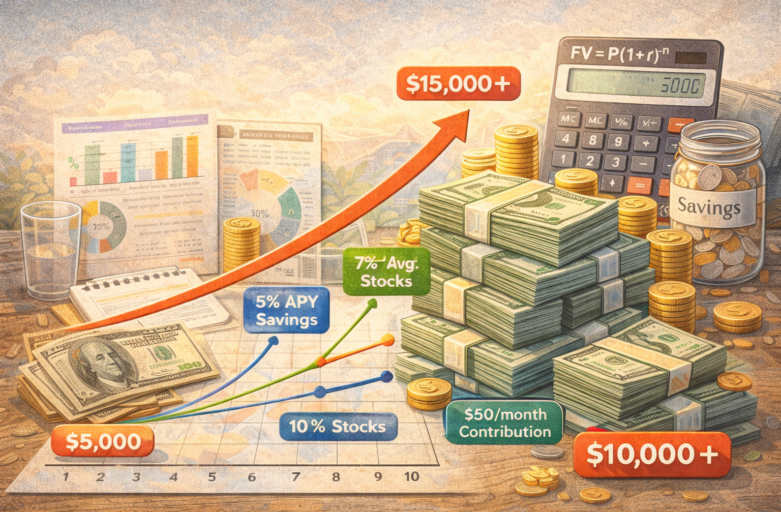
So, how much will $5,000 grow in 10 years? Savings: $7,400-$8,100. Stocks/index funds: $9,800-$13,000. With extras like contributions? Sky’s the limit, potentially $15,000+. The magic? Compound interest at work, fueled by smart choices.

You’re now armed to act. Grab that $5,000, pick your path, and watch it grow. Future you is cheering! What’s your first move—savings bump or stock dive?
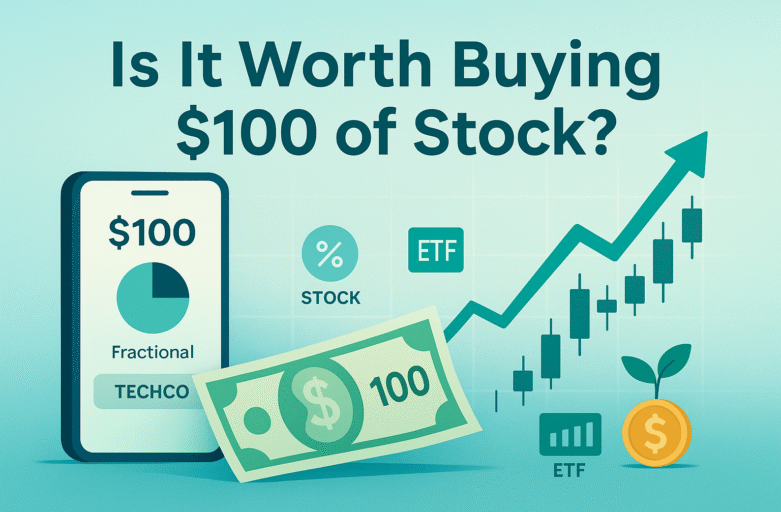
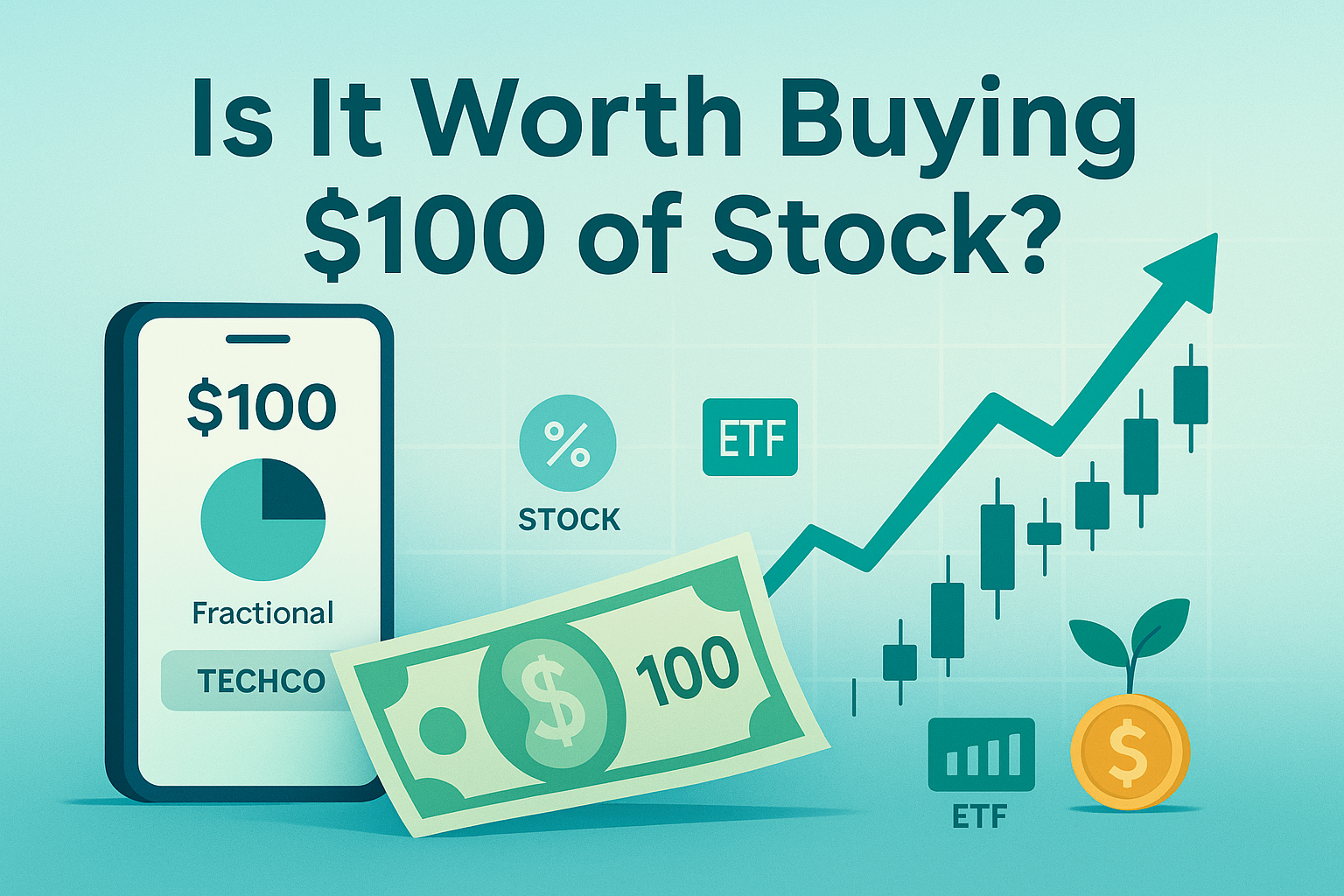
Is It Worth Buying $100 of Stock?

Is It Worth Buying $100 of Stock

If you’ve been wondering whether investing $100 in stocks is a smart move, you’re not alone. Many beginners and casual investors ask this exact question when starting their investment journey. The simple answer is yes, but the details make it even more interesting. Let’s explore what buying $100 of stock means for you and if it’s worth your money.


Why $100 Can Be a Great Starting Point for Stock Investing

You might think $100 is too small to make any difference, but that’s not true. Investing even a small amount sets you on the right path toward growing your money over time. Stocks let you buy ownership in companies, and over the years, that ownership can grow in value.

With $100, you can purchase shares of many companies or even fractional shares of expensive stocks, giving you flexibility. This means you don’t have to wait until you save thousands before you start investing. Starting with $100 helps you learn how the stock market works with limited risk.


How $100 in Stocks Can Grow Over Time

When you buy stock, your returns depend on how the companies perform and the overall market conditions. If a company grows and earns more profits, the value of your stock usually rises. Over many years, this growth can turn your $100 into a much bigger amount thanks to the power of compounding.

Let’s say you invest $100 today and your investment grows 7% annually on average—a realistic return for a diversified stock portfolio. After 10 years, your $100 could grow to nearly $200 without you adding a single cent. That’s doubling your money just by letting it sit and grow.


Benefits of Buying $100 of Stock for Beginners

You don’t need a lot of money to jump into investing, and buying $100 of stock helps you get used to how the market works. Here are some benefits you enjoy by starting with $100:

  • Builds Good Investing Habits: Regularly putting money into stocks encourages disciplined saving and investing.
  • Teaches Market Basics: You learn how prices fluctuate, how dividends work, and the importance of patience.
  • Reduces Risk: With a small investment, you limit potential losses while gaining valuable experience.
  • Opens Access to Big Companies: Many platforms let you buy fractions of shares, so you can own a piece of expensive stocks like Apple or Amazon for less than $100.

Common Concerns About Small Stock Investments

You may worry that $100 gets eaten up by fees or won’t buy meaningful shares. Fortunately, many online brokers offer zero-commission trading, so your $100 goes fully into the stock. Also, fractional share investing means $100 can still get you started in companies with high share prices.

Another concern is that gains may seem small. While $100 may not buy a mansion instantly, consistent investing can build considerable wealth over time. Remember, every big investor started somewhere, and $100 is a solid beginning.


Key Tips to Make Your $100 Stock Purchase Worthwhile

  • Choose Low-Fee Platforms: Avoid brokers that charge high fees or commissions that reduce your investment.
  • Diversify When Possible: Invest in ETFs or multiple stocks to reduce risk.
  • Be Patient and Consistent: Don’t expect overnight riches. Invest regularly even with small amounts.
  • Educate Yourself: Read about investing basics to make informed decisions and avoid panic selling.

So Is Buying $100 of Stock Worth It?

In summary, buying $100 of stock can be a smart and practical way to start investing. It gives you exposure to the market, builds your investing skills, and can grow your money over time. With the right approach, $100 isn’t small; it’s a stepping stone toward financial growth. So if you’ve been on the fence, go ahead and make your first $100 stock purchase today — your future self will thank you!

How Much Will You Have in 30 Years If You Invest $1,000 a Month?

How Much Will You Have in 30 Years If You Invest $1,000 a Month?

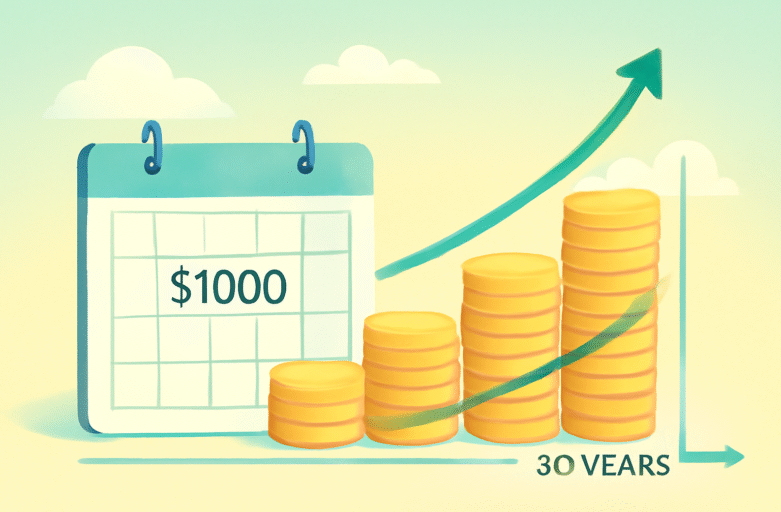
If you’re wondering how much money you could make by investing $1,000 every month for 30 years, you’re asking a smart question. Investing consistently over such a long period can build a surprisingly large nest egg. Let’s break it down in a way that’s easy to understand so you can see the potential growth of your money.


What Happens When You Invest $1,000 Every Month?

Investing $1,000 monthly is like planting seeds regularly in a garden. At first, it might not look like much. But each little bit you add grows, plus it earns returns that get reinvested month by month. This process is called “compound interest,” which means your money earns interest, and then that interest earns more interest. Over 30 years, compound interest can turn your regular $1,000 deposits into a significant sum.

You may want to know exactly how much that is. The final amount depends on the rate of return you get from your investments. Commonly, people use the stock market as an example because historically it averages around 7% annual return after inflation. Keep in mind, this is an average; some years can be higher or lower.


Let’s Do the Math: How Much Could You Have?

To find out how much your investments will grow, we use a formula to calculate the future value of monthly investments with compound interest. But don’t worry—here’s a simple way to follow along without getting buried in math.

  • You invest $1,000 every month.
  • The investment period is 30 years.
  • Assume an average annual return of 7%, compounded monthly.

Using those numbers, you can expect your investment to grow to approximately $1.25 million. Yes, that’s over a million dollars just by putting away $1,000 a month!

Here’s a quick way to think about it: You would have contributed $360,000 (which is $1,000 x 12 months x 30 years). The rest, about $890,000, is the growth from investment returns.


What if Your Interest Rate Changes?

The 7% rate is a common guess, but what if your investments grow faster or slower? Here’s an estimate of how different annual return rates can impact your $1,000 monthly investment over 30 years:

  • 5% return: around $757,000 total
  • 7% return: around $1.25 million total
  • 10% return: about $1.76 million total

This shows that even a small change in the return rate matters a lot over time. The higher the return, the more your investments grow.


Why Should You Keep Investing Regularly?

One key to hitting these numbers is consistency. Investing $1,000 every single month without interruption beats trying to time the market or relying on a lump sum. Regular investing takes advantage of dollar-cost averaging, which reduces the risk of buying when prices are too high.

Also, investing monthly helps you build discipline and keeps you on track to reach your financial goals. Even if the market dips, your monthly investing keeps going, so you buy more shares cheaply and set yourself up for better growth when the market rebounds.


What Types of Investments Can Help You Achieve This?

You might wonder where to put your $1,000 each month to reach that 7% or 10% return. Popular choices include:

  • Stock market index funds: These track a whole market like the S&P 500, giving you broad exposure to many companies.
  • Mutual funds: Managed portfolios picking stocks or bonds based on specific strategies.
  • Exchange-Traded Funds (ETFs): Like mutual funds, but traded like stocks.
  • Retirement accounts (401(k), IRA): These accounts offer tax benefits and are great for long-term investing.

Generally, investing in a mix of stocks and bonds based on your risk tolerance is wise. Stocks tend to give higher returns over time but are more volatile. Bonds offer stability but usually lower returns.


Will Inflation Affect Your $1.25 Million?

Good question! Inflation means the prices of everything go up over time, so your money’s buying power may shrink. While $1.25 million sounds like a lot today, in 30 years, it may not buy as much as you think.

For example, if inflation averages 3% per year, the real (inflation-adjusted) value of that $1.25 million will be roughly $470,000 in today’s dollars. This means your investment still grows, but you should plan your retirement spending accordingly.

That’s why many financial advisors suggest aiming for a mix of growth and inflation protection, like stocks and some inflation-protected bonds, to keep your money’s value intact.


What You Should Do Now

If you want a comfortable future or early retirement, consistently investing $1,000 monthly puts you on a strong path. Over 30 years, even a moderate return turns your small monthly deposit into a life-changing sum of money.

You don’t need to be a financial expert to start. Choose a simple investment plan, like low-cost index funds, and commit to investing every month. The power of compounding and regular investing will do the heavy lifting.

Remember: the sooner you start, the more time your money has to grow. Even small amounts can turn into thousands or millions over decades, just by staying patient and consistent.

So, ask yourself—what if you started today? Your future self might thank you tremendously.

Is $100 Enough to Invest in Stocks?

Are you wondering if $100 is enough to start investing in stocks? You’re not alone! Many people think you need thousands of dollars to begin, but the truth is, you can start your investing journey with just $100. Let’s break down exactly how you can make your first $100 work for you in the stock market, what you should expect, and how to get started with confidence.


Can You Really Invest in Stocks With Only $100?

Absolutely! The days when you needed a lot of money to buy stocks are gone. Thanks to technology, investing has become more accessible than ever. Many online brokerages and investing apps let you start with as little as $1. This means your $100 is more than enough to open an account and buy your first shares.

You don’t have to buy a whole share of expensive companies like Apple or Amazon. Fractional shares allow you to own a piece of a stock, even if you can’t afford a full share. So, if a stock costs $500, you can still invest $10 or $20 in it and own a fraction of that company.


What Are Your Options With $100?

With $100, you have several choices for how to invest in stocks. Here are some of the most popular and beginner-friendly options:

1. Fractional Shares

Fractional shares let you buy a portion of a stock, making it easy to invest in big-name companies. Many platforms like Robinhood, Fidelity, and Charles Schwab offer this feature. You can spread your $100 across different companies or put it all into one you believe in.

2. Exchange-Traded Funds (ETFs)

ETFs are a basket of stocks you can buy with a single purchase. They’re great for beginners because they offer instant diversification. With $100, you can buy shares or even fractional shares of popular ETFs that track the whole market, like the S&P 500.

3. Dividend Stocks

Some stocks pay dividends, which are small payments to shareholders. While $100 won’t make you rich from dividends, it’s a fun way to see your money grow a little over time. Reinvesting those dividends can help your investment snowball.


How to Invest $100 in Stocks Step-by-Step

Ready to put your $100 to work? Here’s a simple step-by-step guide:

  1. Pick a Brokerage: Choose an online broker or investing app with no account minimums and low fees. Popular choices include Robinhood, Fidelity, E*TRADE, and Charles Schwab.
  2. Open an Account: Sign up and link your bank account. Most platforms make this process quick and easy.
  3. Deposit Your $100: Transfer your $100 into your new brokerage account.
  4. Decide What to Buy: Research stocks or ETFs you’re interested in. Look for companies or funds you believe will grow over time.
  5. Place Your Order: Use your $100 to buy stocks, ETFs, or fractional shares. You can split your money or go all-in on one investment.
  6. Sit Back and Watch: Track your investment, but don’t obsess over daily changes. Investing is a long-term game.

What Can You Expect When Investing $100?

You probably won’t get rich overnight with $100, but that’s not the point. The real value is learning how the stock market works and building good investing habits. Here’s what you can expect:

  • Experience: You’ll learn how to use investing platforms, read stock charts, and understand basic financial terms.
  • Growth Potential: If your investments do well, your $100 could grow over time. Even small gains teach you the power of compounding.
  • Confidence: Starting small helps you build confidence so you can invest more in the future.

Tips to Make the Most of Your $100 Investment

  • Diversify: Don’t put all your eggs in one basket. Consider spreading your $100 across a few different stocks or ETFs.
  • Avoid High Fees: Choose a brokerage with low or no trading fees so your $100 goes further.
  • Think Long-Term: Stocks can go up and down in the short term, but history shows they tend to grow over time.
  • Keep Learning: Read articles, watch videos, and follow market news to become a smarter investor.

Common Questions About Investing $100 in Stocks

Is $100 Really Enough to Make a Difference?

Yes, $100 is enough to get started. The most important step is beginning your investing journey. Over time, even small amounts can grow, especially if you continue to invest regularly.

What If I Lose My $100?

All investing involves risk. Stocks can go up or down. Start with money you can afford to lose, and remember that losses are part of the learning process. By diversifying and thinking long-term, you can reduce your risk.

Should I Wait Until I Have More Money?

You don’t have to wait. Starting now helps you learn and build good habits. Even if you only have $100, you’re taking action toward your financial goals.

The Power of Starting Small

Many successful investors started with small amounts. The key is consistency. If you invest $100 now and add a little more each month, your portfolio can grow over time. Small steps today can lead to big results in the future.


Your $100 Is a Ticket to the Stock Market

You don’t need to be rich to start investing in stocks. With $100, you can open a brokerage account, buy stocks or ETFs, and begin your journey toward financial growth. The most important thing is to start, learn as you go, and keep building your investment over time.

So, is $100 enough to invest in stocks? Yes! Your $100 is more than just money—it’s your first step toward building wealth and learning how to make your money work for you. Take that step today, and who knows where your investing journey will take you!

How much money do I need to invest to make $1000 a month?

how much money to invest

To generate a monthly income of $1,000 through investments, you need to consider several factors, including the type of investment, the amount you invest, and the expected rate of return. This blog post will explore how much money you need to invest to achieve that goal, along with various investment strategies that can help you get there.


Understanding Your Investment Goals

Before diving into specific numbers, it’s crucial to understand your investment goals. You want to make $1,000 a month, which translates to an annual income of $12,000. To achieve this through investments, you need to determine how much capital you need to invest based on your expected rate of return.


The Role of Rate of Return

The rate of return is the percentage of profit you earn on your investments. Different investment types offer varying rates of return. For example:

  • Stocks: Historically, the stock market has returned about 10% annually.
  • Real Estate: Depending on the location and type of property, real estate can yield returns between 8% and 12%.
  • Bonds: These typically offer lower returns, around 3% to 5%.

To estimate how much you need to invest, you can use the formula:

Investment Needed = (Desired Income) / (Rate of Return)


Calculating Your Investment Needs

To make $1,000 a month or $12,000 a year, let’s explore different scenarios based on varying rates of return.

Scenario 1: Investing in Stocks (10% Return)

Using the formula mentioned above:

Investment Needed =(12,0000 / 0.10) = 120,000

You would need to invest $120,000 in stocks at a 10% annual return to generate $1,000 a month.

Scenario 2: Investing in Real Estate (8% Return)

For real estate with an 8% return:

Investment Needed =(12,0000 / 0.08 ) = 150,000

In this case, you would require $150,000 invested in real estate.

Scenario 3: Investing in Bonds (4% Return)

If you choose bonds with a 4% return:

Investment Needed = (12,0000 / 0.04) = 300,000

Here, you would need a substantial $300,000 invested in bonds to achieve your monthly income goal.


Exploring Different Investment Options

Now that we have established how much money you might need based on various returns let’s look at some investment options that can help you reach your goal.

1. Dividend-Paying Stocks

Investing in dividend-paying stocks is one popular way to generate passive income. Companies that pay dividends typically have stable earnings and are less volatile than growth stocks. By investing in these stocks and reinvesting dividends over time, you can build a significant income stream.

2. Real Estate Investment Trusts (REITs)

REITs allow you to invest in real estate without having to buy properties directly. They often pay dividends that can provide regular income. Platforms like Fundrise or Arrived enable you to invest smaller amounts into various real estate projects.

3. Peer-to-Peer Lending

Peer-to-peer lending platforms let you lend money directly to individuals or small businesses in exchange for interest payments. While this can be riskier than traditional investing methods, it often yields higher returns.

4. Index Funds

Investing in index funds is another excellent strategy for generating passive income. These funds track specific market indices and typically have lower fees than actively managed funds. Over time, they can provide solid returns while minimizing risk through diversification.


Strategies for Building Your Investment Portfolio

Building an investment portfolio requires careful planning and consistent contributions over time. Here are some strategies that can help maximize your chances of reaching your $1,000 monthly goal:

1. Start Early and Contribute Regularly

The earlier you start investing and the more consistently you contribute, the better your chances of reaching your financial goals due to the power of compounding interest.

2. Diversify Your Investments

Don’t put all your eggs in one basket! By diversifying across different asset classes—stocks, bonds, real estate—you reduce risk and increase potential returns.

3. Reinvest Earnings

Instead of cashing out dividends or interest payments immediately, consider reinvesting them into your portfolio. This strategy accelerates growth and helps compound your wealth over time.

4. Keep Learning

Stay informed about market trends and investment strategies by reading books or following financial news outlets. Knowledge is power when it comes to making smart investment decisions.


In summary, how much money do you need to invest to make $1,000 a month? The answer depends on the type of investments you choose and their expected rates of return. You could need anywhere from $120,000 for stocks at a 10% return up to $300,000 for bonds at a 4% return. By understanding your investment goals and exploring various options like dividend-paying stocks or REITs while employing strategies like diversification and reinvestment, you’ll be well on your way toward achieving that monthly income target. Remember that investing is a journey; stay patient and keep learning along the way!