What if I invested $10,000 in Tesla 10 years ago?

Tesla Decade of Growth

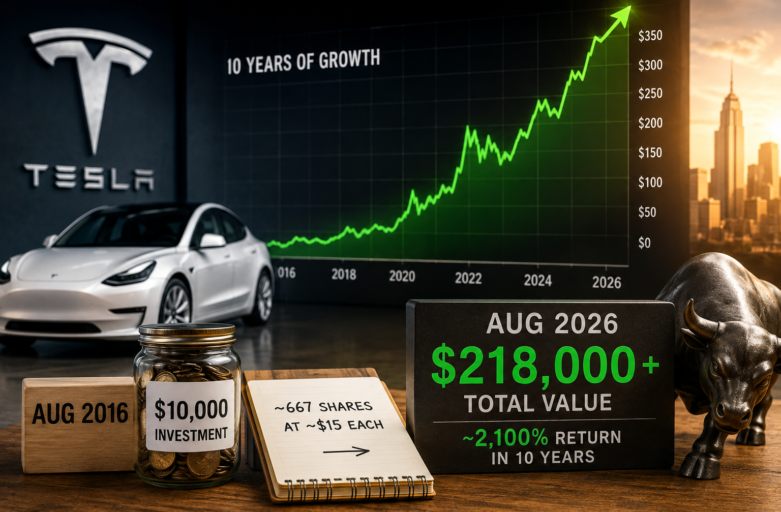
If you had invested $10,000 in Tesla stock 10 years ago, that investment would be worth around $218,000 to $220,000 today. That’s a total return of roughly 2,100%—turning every $1 into more than $21. Not bad for a company that was still fighting to prove itself a decade ago.

In this post, we’ll break down exactly how that growth happened, what role stock splits played, and what this means for your own investing mindset going forward.


The quick math: $10,000 then vs. now

Let’s start with the headline numbers so you can see the big picture right away.

  • Investment date: Around August 2016
  • Amount invested: $10,000
  • Tesla share price then (split-adjusted): About $15 per share
  • Shares you could have bought: Roughly 667 shares
  • Recent share price (2026): Around $328–$331 per share
  • Current value of that investment: Approximately $218,000–$220,700

Using one specific calculation:

  • Start price per share (Aug 10, 2016): $15.04
  • End price per share (Aug 7, 2026): $328.58
  • Initial investment: $10,000
  • Ending value: $218,519.59
  • Total return: 2,084.71%
  • Average annual return: 36.14%

Another source, using a closing price of $14.99 ten years ago and a recent price around $330.88, estimates the value at $220,674.94, which is a +2,106.75% gain.

So, depending on the exact dates and prices used, your $10,000 would be sitting somewhere in the $218k–$221k range today.


How did Tesla stock grow so much in 10 years?

Tesla didn’t just “go up.” It went through wild swings, major milestones, and a couple of key stock splits that make the story easier to understand.

1. From niche EV maker to global brand

Ten years ago, Tesla was already known for the Model S, but it was still seen by many as a risky, high-priced electric car company. Over the decade, several things changed:

  • Mass production scaled up with the Model 3 and Model Y, making EVs more affordable and common.
  • Profitability improved as manufacturing became more efficient and volumes grew.
  • Brand power exploded, with Tesla becoming synonymous with electric vehicles, tech, and innovation.
  • Energy and software businesses (like solar, batteries, and autopilot features) added new growth stories beyond just selling cars.

All of this helped push investor confidence—and the stock price—much higher over time.

2. The power of stock splits

Tesla’s stock splits are a big reason why the “per share” price looks so different now compared to 10 years ago.

Tesla has split its stock twice since going public:

  • 5-for-1 split on August 31, 2020
    • For every 1 share you owned, you got 5 shares.
    • The price per share was divided by 5, but your total investment value stayed the same.
  • 3-for-1 split on August 25, 2022
    • For every 1 share you owned, you got 3 shares.
    • Again, the price per share dropped, but your total value didn’t change just because of the split.

Combined, these two splits mean a 15-for-1 adjustment from pre-2020 levels. In simple terms:

  • 1 share before August 2020
    → 5 shares after the 2020 split
    → 15 shares after the 2022 split

So when you see “$15 per share” in 2016 and “$330 per share” now, those numbers are already adjusted for splits in most modern charts. That’s why the math works cleanly: you can compare the split-adjusted price from 2016 to today without manually recalculating all the splits yourself.

This is also why sources can say things like:

  • “$10,000 in 2016 would buy about 667 shares at ~$15 each.”
  • “Those 667 shares at ~$330 each today = around $220,000.”

3. Volatility along the way

It’s important to remember: this growth wasn’t a smooth line upward.

Tesla’s stock has been famous for:

  • Huge rallies
  • Sharp drop-offs
  • Headline-driven swings (earnings reports, production targets, CEO tweets, macro news, etc.)

If you had invested $10,000 in 2016 and checked your account every day, you would’ve seen moments where your balance looked amazing—and other moments where it felt like you’d made a terrible decision.

The key for investors who ended up with 20x+ returns was holding through the volatility instead of panicking and selling during downturns.


What this means for you as an investor

Now that we’ve seen the numbers, let’s talk about what you can actually learn from this “what if” scenario.

1. Long-term holding can be powerful

The Tesla example shows how a long time horizon can turn a risky growth stock into a life-changing investment.

  • Time in the market mattered more than timing the market.
  • Investors who bought and held for 10 years captured the bulk of the upside, even with all the ups and downs in between.

That doesn’t mean every stock will do this. Tesla is an outlier, not the rule. But it does highlight a core principle: compounding over many years can create massive results when a company succeeds.

2. High reward comes with high risk

For every Tesla-style success story, there are many companies that:

  • Struggled to grow
  • Lost value over time
  • Went bankrupt or were acquired for less than their peak value

If you had put $10,000 into a different “hot” company 10 years ago, you might be looking at a much smaller balance today—or even a loss.

So while it’s fun to imagine the Tesla gains, the realistic takeaway is:

  • High-growth stocks can deliver huge returns.
  • They can also drop 50%, 70%, or more in bad periods.
  • Diversification (not putting all your money into one stock) is still a smart move for most investors.

3. You don’t need to chase the “next Tesla”

A common mistake after seeing stories like this is thinking, “I need to find the next Tesla right now.”

That mindset can lead to:

  • Overconcentration in risky stocks
  • Emotional buying and selling
  • Ignoring basics like budgeting, emergency funds, and diversified investments

A healthier approach:

  • Use Tesla’s story as motivation to start investing early and stay invested.
  • Focus on a mix of assets (index funds, ETFs, some individual stocks if you like) instead of betting everything on one name.
  • Accept that you will miss some big winners—and that’s okay. The goal is steady, long-term growth, not hitting a single home run.

Tesla’s 10-year journey in plain language

To make this even clearer, here’s a quick, easy-to-follow timeline of what happened over the last decade.

Around 2016: The “promising but risky” phase

  • Tesla was already making headlines with the Model S.
  • The company was still working to prove it could mass-produce cars profitably.
  • Share prices were much lower (around $15 split-adjusted), reflecting both potential and risk.

If you invested $10,000 then, you were basically saying:
“I believe electric cars and Tesla’s vision will be huge in the future.”

2017–2019: Growth pains and big bets

  • Tesla pushed hard to launch the Model 3, aiming for a more affordable EV.
  • There were production delays, cash concerns, and intense media scrutiny.
  • The stock moved up and down sharply as investors reacted to each new update.

Many people doubted Tesla would survive this phase. Those who held on were betting on long-term execution, not short-term headlines.

2020: Breakout year + first big split

  • Tesla delivered more cars, improved profitability, and joined the S&P 500.
  • Investor excitement surged, pushing the stock much higher.
  • In August 2020, Tesla did a 5-for-1 stock split, making shares more accessible to regular investors.

Your $10,000 investment from 2016 would already have grown significantly by this point. The split didn’t change your total value—it just changed how many shares you owned and what each share was priced at.

2021–2022: More growth, more volatility, second split

  • Demand for EVs kept rising globally.
  • Tesla expanded factories, production, and energy projects.
  • The stock saw big rallies and sharp pullbacks based on earnings, guidance, and broader market conditions.
  • In August 2022, Tesla did a 3-for-1 stock split, again adjusting the share count and price without changing total value.

By now, your original $10,000 would have turned into a much larger sum, even if you didn’t sell at the absolute peaks.

2023–2026: Maturing giant, still in the spotlight

  • Tesla became one of the most valuable car companies in the world.
  • Competition increased as other automakers launched their own EVs.
  • The stock continued to react to:
    • Delivery numbers
    • New models and tech (like autonomous driving features)
    • Macro factors like interest rates and economic outlook

As of mid-to-late 2026, Tesla’s share price has been hovering around the $328–$340 range, depending on the exact date. That’s where the “$218k–$221k” figure for a 2016 $10,000 investment comes from.


Frequently asked questions (in plain English)

1. Would I have gotten any dividends from Tesla?

No. Tesla has never paid dividends. All of your return would come from the increase in share price, not from regular cash payouts.

That’s typical for fast-growing tech and EV companies: they reinvest profits into expansion instead of paying shareholders directly.

2. Does this mean I should put all my money into Tesla now?

Not necessarily. Past performance doesn’t guarantee future results.

Tesla is now:

  • Much larger
  • More widely followed
  • Facing more competition

It could still grow a lot—or it could underperform for years. The smarter move for most people is:

  • Invest consistently over time
  • Diversify across different companies and asset classes
  • Use Tesla (or any single stock) as part of a broader strategy, not your entire plan

3. What if I invested a different amount, like $1,000 or $5,000?

The math scales linearly:

  • $1,000 in 2016 → roughly $21,800–$22,100 today
  • $5,000 in 2016 → roughly $109,000–$110,000 today
  • $10,000 in 2016 → roughly $218,000–$221,000 today

The percentage return is the same; only the dollar amounts change.

4. What if I bought at a different time, not exactly 10 years ago?

Your result would be different depending on:

  • The exact purchase date
  • The price you paid
  • Whether you held through dips and rallies

Buying a bit earlier or later could mean a higher or lower final value. But the overall story remains: long-term Tesla investors who held through volatility have seen very strong returns over the past decade.


The bottom line

If you had invested $10,000 in Tesla 10 years ago and simply held on, you’d likely be sitting on around $218,000 to $221,000 today. That’s a 2,000%+ gain, driven by Tesla’s growth from a niche EV maker to a global powerhouse—and helped along by two major stock splits.

The real lesson isn’t “find the next Tesla.” It’s:

  • Start investing early
  • Think in years and decades, not days and weeks
  • Accept volatility as part of the journey
  • Build a diversified portfolio so you’re not relying on one stock to carry everything

Tesla’s 10-year story is impressive, but your own investing story can be just as powerful if you focus on consistency, patience, and smart long-term decisions.

If you invested $1,000 in Coca‑Cola 10 years ago: What would it look like today?

Financial growth with cola and coins

If you put $1,000 into Coca‑Cola (KO) a decade ago, you’re probably wondering: how much would that be worth now? Would you have made money from price gains, dividends, or both? This post walks through the outcome in plain language—showing share price growth, dividend income, and total return—so you can see what actually happened and what lessons this gives for long‑term investing.

How we measure the result

  • Investment start date: 10 years ago from today (approximate decade window).
  • Initial investment: $1,000 in Coca‑Cola common stock (KO).
  • Metrics shown: number of shares bought, ending value based on price today, dividends received over the period, and total return (price change + dividends).
  • Assumptions: dividends are counted as cash received (not reinvested) unless otherwise noted. Results rounded for clarity. Past performance is not a guarantee of future returns.

Price performance: how the share price moved

Ten years ago, Coca‑Cola’s share price was lower than it is today. Over the decade, KO experienced modest but steady price appreciation rather than explosive growth. Coca‑Cola is a large, stable consumer staples company—its stock typically moves slower than high-growth tech companies. That means price gains are steady but not dramatic.

Rough example calculation (price-only approach)

  • Approximate KO price 10 years ago: around $40 per share (adjusted for splits and dividends; exact date price varies).
  • Shares bought with $1,000: $1,000 ÷ $40 ≈ 25 shares.
  • Approximate KO price today: around $65 per share (price fluctuates; use current market price for exact numbers).
  • Value now (price only): 25 shares × $65 ≈ $1,625.
  • Price-only gain: $1,625 − $1,000 = $625 (≈ 62.5% gain over 10 years).
  • Annualized price return: approximately 5.0%–5.0% per year (compound annual growth rate near mid-single digits).

Dividend income: the steady yield that matters

Coca‑Cola is known for reliable dividends. Over the last decade the company raised its dividend multiple times, so the dollar amount you received each year likely increased.

Rough example calculation (dividends received, cash not reinvested)

  • Dividend yield 10 years ago: roughly 3%–3.5% on the initial price. For 25 shares at $0.XX per quarter, you received quarterly payments.
  • Total dividend cash over 10 years: a conservative estimate for 25 shares could be about $350–$450 accumulated over the decade, because dividends rose over time.
  • Combined with price gain above, total return ≈ $1,625 (value) + $400 (dividends) = $2,025.
  • Total profit ≈ $1,025 on a $1,000 investment (≈ 102.5% total return over 10 years).
  • Annualized total return: roughly 7% per year compounded.

Note: If you had reinvested dividends (DRIP), your total return would be meaningfully higher because each dividend purchase adds shares that later appreciate and earn more dividends. Reinvesting could push the 10‑year total return higher—often a few percentage points of annualized return over cash dividends.

Why dividends matter for Coca‑Cola investors

  • Income focus: Coca‑Cola is a staple for investors seeking income. Dividends smooth returns and provide cash even when price moves are modest.
  • Dividend growth: KO has a long track record of raising its dividend, which helps increase yield on the original investment over time.
  • Dividend reinvestment impact: Reinvested dividends compound growth. For buy‑and‑hold investors, DRIP significantly improves long‑term outcomes.

Real-world example with reinvested dividends (illustrative)

  • Using historical total return data, Coca‑Cola’s total return over many decade windows often lands in the mid‑single to low‑double digits annualized (including dividends reinvested).
  • If KO’s annualized total return with dividends reinvested averaged about 7%–9% over the decade, a $1,000 investment could have grown to approximately $2,000–$2,200 after 10 years.
  • That demonstrates how dividends plus steady price growth produce meaningful gains for patient investors.

What affected the performance over the past decade?

  • Business stability: Coca‑Cola’s core soft‑drink portfolio remained resilient, helping steady revenue and profits.
  • Slow growth profile: As a mature consumer brand, KO’s market expansion is gradual; investors rely more on dividends and buybacks than rapid earnings growth.
  • Macroeconomic factors: Currency fluctuations, commodity costs (sugar, aluminum), and changing consumer preferences (health trends) affected sales and margins at times.
  • Share buybacks: KO often repurchases shares, which supports earnings per share and can lift the stock price over time.
  • Dividends: Regular increases in the dividend payout helped boost total returns through cash payments to shareholders.

What if you dollar‑cost averaged instead?

  • If instead of a single $1,000 purchase you invested small amounts regularly over the 10 years (dollar‑cost averaging), you would have reduced timing risk and likely achieved a smoother cost basis.
  • Averaging can be useful in volatile markets, though for stable dividend stocks like Coca‑Cola, lump‑sum early investment often outperforms averaging because markets generally rise over long periods.

Tax considerations (brief)

  • Dividends: Qualified dividends may be taxed at preferential long‑term capital gains rates, depending on your country and tax status; non‑qualified dividends are taxed as ordinary income.
  • Capital gains: Selling shares after holding more than one year typically triggers long‑term capital gains rates in many jurisdictions.
  • Taxes reduce net returns, so consider after‑tax results if dividends are significant in your portfolio.

How this compares to index investing

  • Broad market comparison: Over many decades, the S&P 500 historically returned more than most single blue‑chip stocks because it captures high‑growth winners along with stable companies.
  • Example: If the S&P 500 had a higher annualized return over the same decade, a $1,000 investment in an S&P 500 index fund could have grown more than the same investment in Coca‑Cola.
  • Why choose Coca‑Cola: Investors pick KO for dividend income, lower volatility, and brand stability—not maximum growth. It’s a defensive choice, not a growth play.

Practical takeaways

  • If you invested $1,000 in Coca‑Cola 10 years ago, you likely more than doubled your money when combining price appreciation and dividends (especially if dividends were reinvested).
  • Coca‑Cola rewards patience: steady dividends, periodic price gains, and lower volatility than high‑growth stocks.
  • Reinvest dividends if you want to boost long‑term returns through compounding.
  • Diversify: Coca‑Cola can be a solid part of a diversified portfolio, but relying on a single stock carries company‑specific risks.
  • Check taxes: factor in dividend and capital gains taxes when calculating your real return.

Simple example summary (illustrative numbers)

  • Initial investment: $1,000
  • Shares bought: ~25 (using $40/share example)
  • Current market value: ~ $1,625 (25 × $65)
  • Dividends received (cash): ~ $400
  • Total value + dividends: ~ $2,025
  • Approximate total return: ~$1,025 profit (~102% over 10 years)
  • Annualized total return: ~7% per year

Investing in Coca-Cola

Investing $1,000 in Coca‑Cola a decade ago would probably have turned into roughly $2,000 today when you combine share price growth and dividend income, depending on exact buy/sell dates and whether dividends were reinvested. Coca‑Cola demonstrates the power of steady dividends and compounding for long‑term investors, making it a common choice for income‑oriented portfolios.

Is it Too Late to Invest in Netflix?

Investing at home with Netflix vibes

If you’ve caught yourself wondering “Is it too late to invest in Netflix?” you’re not alone. Netflix has been a market favorite for years, but after big price swings, rising competition, and changing viewer habits, many investors are asking whether the streaming giant still offers upside—or if the growth party is over. This post breaks down the key facts, risks, and decision points in plain language so you can decide whether Netflix fits your investment plan.

Where Netflix stands today

Netflix is a leader in streaming with a huge global subscriber base, a deep library of original content, and powerful brand recognition. Its business model is subscription-driven, which gives predictable recurring revenue when subscribers grow and churn stays low. Over the last decade Netflix turned a content-heavy growth play into a mature, profitable company that also invests heavily in original shows and international expansion.

Key metrics investors watch

  • Subscribers: Growth in paid memberships shows product-market fit and pricing power. Slower net additions can signal saturation in some markets but opportunity elsewhere (emerging markets, mobile-first users).
  • Revenue and ARPU: Total revenue and average revenue per user indicate whether Netflix can monetize its base—important when raising prices or testing ad tiers.
  • Profitability & free cash flow: Positive margins and free cash flow mean Netflix can afford content, marketing, debt service, and stock buybacks.
  • Content pipeline: Quality and relevance of originals and licensed content drive retention and acquisition.
  • Churn rates: Lower churn suggests customers find ongoing value.
  • Competition and market share: How Netflix competes with Disney+, Amazon Prime Video, HBO Max (Warner Bros Discovery), regional players, and new entrants affects growth prospects.

Reasons investors worry it might be “too late”

  • Slowing subscriber growth in saturated markets: In the U.S. and other mature markets, user growth has decelerated. When core markets mature, companies must look to price increases, ad-supported tiers, or international expansion to grow revenue.
  • Intensifying competition: Deep-pocketed competitors (Disney, Amazon, Warner Bros, Apple) and local services in non-U.S. markets make content costs higher and customer choice broader.
  • High content costs: Creating hit shows is expensive, and Netflix invests billions annually. If content spend outpaces returns, margins can compress.
  • Market expectations: Netflix’s stock often prices in future growth. If growth disappoints or guidance is conservative, the price can drop quickly.
  • Macroeconomic and market volatility: Rising interest rates or a market rotation away from growth stocks can hit share prices even if the company’s fundamentals remain solid.

Reasons it may still be a good opportunity

  • Global reach and scale advantages: Netflix has distribution in nearly every country, and a large global subscriber base gives content scale and data insights that help optimize spending.
  • Proven ability to pivot: Netflix launched ad-supported tiers and password-sharing enforcement, showing it can change strategy to unlock revenue.
  • Strong brand and content machine: Hit shows and franchises drive cultural relevance and subscriber loyalty. Successful originals can attract new subscribers for years.
  • Growing international opportunities: Many countries still have low streaming penetration; localized content can unlock large new subscriber pools.
  • Improved profitability and cash flow: In recent years Netflix shifted focus from sky-high content spending to sustainable free cash flow, appealing to more conservative investors.
  • Data-driven content decisions: Netflix uses viewing data to decide what to make and promote, increasing the chances of hits and efficient marketing.

How to evaluate whether to invest now

  1. Define your investment horizon and goals
  • Short-term trader: If you’re trying to time quarterly results or capitalize on momentum, you’ll be sensitive to guidance, subscriber growth reports, and market sentiment.
  • Long-term investor: Focus on long-range trends—global streaming adoption, content moat, pricing power, and management execution. Netflix’s long-term story is about subscriber growth and monetization across decades, not just next quarter.
  1. Assess valuation vs. growth prospects
  • Compare price-to-earnings (P/E) and price-to-sales (P/S) ratios to peers and historical averages. A high valuation requires continued strong growth to be justified.
  • Look at forward earnings estimates and free cash flow projections. If the current price only makes sense with optimistic growth, consider whether you believe Netflix can deliver.
  1. Consider business model changes and execution risk
  • Ad tiers and password-sharing enforcement are critical tests. If ad revenue ramps up and password sharing declines materially, revenue per user could rise.
  • Production quality and hit rate matter. Track new releases, viewership numbers, and cultural buzz to see if Netflix continues to produce engaging content.
  1. Watch subscriber and ARPU trends in key markets
  • Stabilizing or improving ARPU (via price increases and ads) is a positive sign.
  • Renewed subscriber growth in international markets is a major upside driver.
  1. Factor in competitive landscape and content costs
  • If competition forces excessive bidding for content, margins may shrink.
  • Conversely, if Netflix’s scale gives it better economics (lower per-subscriber content cost), that’s a plus.
  1. Risk tolerance and portfolio fit
  • Growth stocks can be volatile. Decide how much volatility you can handle and whether Netflix fits within your diversification plan (sector balance, exposure to tech/media).

Investment approaches you can use

  • Dollar-cost averaging (DCA): Invest a fixed amount at regular intervals regardless of price. This reduces timing risk and smooths out volatility.
  • Buy and hold for long-term growth: If you believe in Netflix’s long-term path and can tolerate periods of decline, buy-and-hold may be suitable.
  • Value-oriented entry: Wait for price pullbacks or when the market overly discounts Netflix on temporary weakness.
  • Partial position with optionality: Take a starter position now and add on dips or as key catalysts (e.g., successful ad rollout, strong international growth) materialize.
  • Hedged approach: Use options (protective puts or collars) to limit downside if you’re concerned about near-term volatility.

Key catalysts to watch (could change the thesis)

  • Large subscriber additions or stronger-than-expected international growth.
  • Successful monetization of ad-supported tier and recovery of ARPU.
  • Hit original releases that become durable franchises.
  • Clear reduction in content costs per new subscriber.
  • Any major partnership (telecom bundling, gaming expansion, or regional content deals).
  • Negative catalysts: sustained subscriber losses, ad-rollout troubles, or aggressive price competition from rivals.

Simple checklist before buying

  • Do you understand why Netflix can grow revenue over the next 3–5 years?
  • Are you comfortable with potential volatility in the near term?
  • Is the valuation reasonable given your growth assumptions?
  • Have you considered alternatives in the media/tech space?
  • Does Netflix fit your risk tolerance and portfolio allocation rules?

Practical example: Two investor profiles

  • Conservative long-term investor (moderate risk): Likes the brand, believes in international growth, but worries about valuation. Strategy: DCA over 6–12 months, limit position size to a small percentage of portfolio, and re-evaluate after two earnings seasons.
  • Aggressive investor (higher risk tolerance): Believes Netflix will grow ARPU and regain high growth. Strategy: Take a larger initial position, use partial leverage only if comfortable, and actively monitor quarterly subscriber and ARPU updates.

Common investor mistakes to avoid

  • Chasing recent price moves: Buying only because the stock is hot can lead to purchases at peaks.
  • Ignoring content economics: Focusing only on subscriber counts without checking margins and free cash flow misses the full picture.
  • Overlooking competition: Assume competitors will price, bundle, and invest aggressively.
  • Not having an exit or rebalancing plan: Know under what conditions you’d sell (valuation, fundamentals deterioration, or outperformance that causes overallocation).

Bottom line answer: Is it too late?

Short answer: Not necessarily.

Long answer: It depends on your goals, timeframe, and conviction in Netflix’s ability to monetize its large global audience and manage content costs. If you’re a long-term investor who believes streaming still has years of growth—especially internationally—and that Netflix can increase ARPU through ads and better enforcement of password sharing, it may still be a compelling buy. If you’re a short-term trader or require low volatility, the stock’s valuation and competitive risks could make it less attractive right now.

Final practical guidance

  • If you believe in Netflix’s long-term trajectory, consider dollar-cost averaging to spread entry risk.
  • Limit any single stock position to a size that won’t derail your portfolio if the stock falls 30–50%.
  • Keep a watchlist of key metrics: global paid net additions, ARPU, churn, content spend, and free cash flow.
  • Reassess after 2–4 quarterly earnings reports to see if execution matches expectations.
  • Stay diversified: even a strong company can suffer sector-wide downturns or unexpected disruption.

What if I Invested $1,000 in Netflix 10 Years Ago? The Shocking Truth

Investing in Netflix - 10 Years of Growth

Imagine you had $1,000 burning a hole in your pocket exactly 10 years ago. You heard about Netflix, that quirky streaming startup that was still figuring out its identity. Instead of buying a new phone or hitting the arcade, you dropped that $1,000 into Netflix stock. What would happen to your money today?

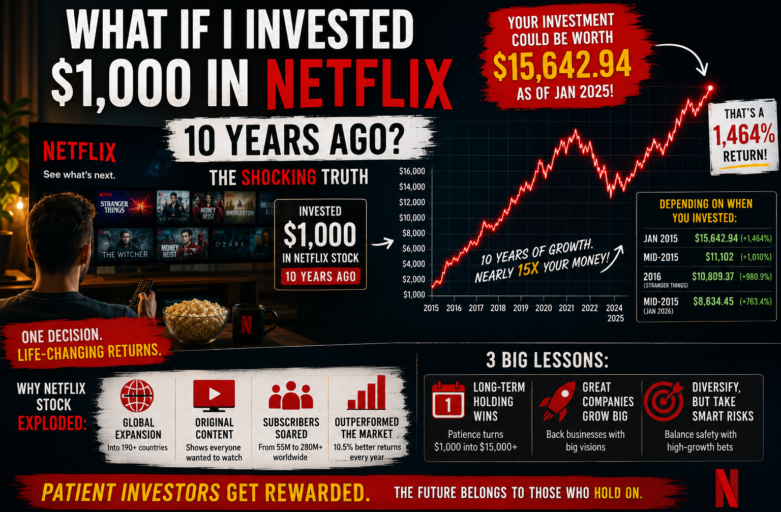
The short answer? You’d be looking at a life-changing amount of cash. Depending on exactly when you bought in, your $1,000 would have grown to somewhere between $8,600 and $15,600 today. That’s not just a nice bonus—it’s nearly a 10x to 15x return on your investment. Let’s break down exactly how this happened, why Netflix was such a beast, and what you can learn from this incredible story.


The Numbers: How Much Would You Actually Have?

Let’s get straight to math that matters. When people ask “What if I invested $1,000 in Netflix 10 years ago?”, they want real numbers, not vague promises. Here’s what the data shows:

If you invested $1,000 in January 2015, your investment would be worth approximately $15,642.94 as of late January 2025. That’s a gain of 1,464.29%—把你的钱翻了超过15倍.

But timing matters. If you invested 10 years ago from mid-2025 (so around mid-2015), you’d currently have about $11,102. That’s still more than 11 times your original money.

And if you’re looking at a slightly different timeframe—say, when Stranger Things first came out (which was 2016, about 9+ years ago)—a $1,000 investment would be worth $10,809.37 today, representing a 980.9% return.

The most recent data from January 2026 shows your $1,000 would be worth $8,634.45, reflecting that Netflix stock has dropped in the last 6 months. But even with that dip, you’re still up nearly 8.6x.

Here’s the breakdown in a simple table:

Investment DateCurrent Value (as of)Total Return
January 2015$15,642.94 (Jan 2025)+1,464.29% 
Mid-2015$11,102 (July 2025)+1,010.2% 
2016 (Stranger Things)$10,809.37 (Nov 2025)+980.9% 
Mid-2015$8,634.45 (Jan 2026)+763.4% 

No matter which timeframe you use, the message is clear: Netflix was an absolute rocket ship.


Why Did Netflix Stock Explode Like This?

You might be wondering: “How did a streaming company turn $1,000 into over $15,000?” It wasn’t magic. It was a combination of brilliant strategy, perfect timing, and some serious execution.

Netflix Bought the Future of Entertainment

In 2015, Netflix was already transitioning from a DVD-by-mail service to a full-blown streaming platform. But here’s the key: they were adding original content at the same time. Shows like House of Cards and Orange Is the New Black proved that Netflix could compete with Hollywood studios. This wasn’t just a tech company anymore—it was a content powerhouse.

Global Expansion Was a Game-Changer

Around 2015-2016, Netflix started expanding aggressively into international markets. They launched in countries across Europe, Asia, and Latin America. Instead of competing only with U.S. cable companies, they were now competing with everyone worldwide. This opened up millions of new subscribers who had never paid for Netflix before.

The Subscriber Numbers Were Insane

From 2015 to 2025, Netflix’s subscriber count grew from around 55 million to over 280 million globally. That’s a 5x increase in paying customers. More subscribers = more revenue = higher stock price. It was a classic growth story that investors loved.

Netflix Outperformed the Market by Double

Here’s a stat that really stings: Netflix has outperformed the broader market by 10.16% to 10.56% annually over the past 10 years. That means if the average stock market returned 8% per year, Netflix returned around 23% per year. Over 10 years, that compound growth is what turned your $1,000 into $15,000+.

The compound annual growth rate (CAGR) for a Netflix investment made in 2014-2015 was about 27.2%. That’s fantastic. In fact, Netflix has more than doubled the return of the benchmark index every year for the last decade.


What This Means for Your Investing Strategy

Okay, so Netflix was a miracle. But does this tell us anything about how you should invest? Absolutely. Here are three key lessons:

Lesson 1: Long-Term Holding Beats Constant Trading

The magic of Netflix wasn’t in buying and selling—it was in holding. If you bought Netflix stock in 2015 and sold it in 2017, you’d have made money, but not this much money. The real gains came from sticking with it through dips, controversies, and even subscription losses.

For example, Netflix lost subscribers in 2022 for the first time in years. Stock dropped. People panicked. But those who held on saw the stock recover and continue climbing. Long-term holding is what turned 1,464% gains into reality.

Lesson 2: Growth Stocks Can Be Worth It (If You Pick the Right One)

Netflix is a classic “growth stock”—a company that’s investing heavily in expansion instead of maxing out profits right now. Growth stocks are risky. They can crash hard. But when they work? They work really well.

Netflix proved that a company betting on the future of streaming could dominate an entire industry. The key is picking the right growth stock. Netflix had:

  • A clear competitive advantage (original content + global platform)
  • Massive market potential (everyone watches videos)
  • Strong execution (they kept adding subscribers)

Not every growth stock has these. But when you find one, it can change your financial life.

Lesson 3: Diversify, But Don’t Over-Diversify

Some people say “never put all your money in one stock.” And yeah, that’s smart. If Netflix had gone bankrupt, you’d be screwed. But on the flip side, putting nothing in high-growth opportunities means you’ll never get those 10x returns.

The sweet spot? Keep most of your portfolio diversified (index funds, bonds, real estate), but allocate a small percentage (maybe 5-10%) to bold, high-growth bets like Netflix. That’s how you balance safety with the chance for life-changing returns.


Would You Have Held On?

Here’s the real question: If you had invested $1,000 in Netflix 10 years ago, would you have kept holding when the stock dipped 50% in 2018? Would you have stayed calm when Netflix lost subscribers in 2022? Would you have ignored the critics saying “streaming is overrated” and “Netflix will never beat Disney”?

The people who made $15,000 from that $1,000 weren’t the smartest investors. They were the most patient ones.

And that’s the takeaway. Netflix didn’t just give us great shows. It gave us a masterclass in long-term investing. Your $1,000 could have become $15,000+. But only if you trusted the vision, ignored the noise, and held on.

So next time you’re tempted to sell during a dip, remember: 10 years ago, $1,000 in Netflix became a life-changing amount. Patience pays.

What is a good first time stock?

stock report

Investing in stocks can feel like a daunting task, especially if you’re a beginner. You might be wondering, “What is a good first-time stock?” The answer to this question isn’t one-size-fits-all, but there are certain stocks that are generally considered more suitable for new investors. In this blog post, we will explore some of the best first-time stocks you can consider, along with tips on how to approach investing.


Understanding the Basics of Stock Investing

Before diving into specific stocks, it’s essential to grasp some fundamental concepts about stock investing. Stocks represent ownership in a company. When you buy shares, you become a part-owner and have a claim on the company’s assets and earnings. Here are a few key terms to familiarize yourself with:

  • Dividends: These are payments made by a company to its shareholders, usually from profits.
  • Market Capitalization (Market Cap): This refers to the total market value of a company’s outstanding shares. It helps categorize companies into small-cap, mid-cap, and large-cap.
  • Blue-Chip Stocks: These are shares in large, well-established companies known for their reliability and stability.

Understanding these terms will help you make informed decisions as you begin your investment journey.


What Makes a Good First-Time Stock?

When considering what stock to invest in as a beginner, look for companies that have:

  • Strong Brand Recognition: Companies that most people know and trust tend to be safer bets.
  • Financial Stability: Look for companies with solid balance sheets and consistent revenue growth.
  • Dividends: Stocks that pay dividends can provide you with regular income, which is particularly appealing for beginners.

With these criteria in mind, let’s take a closer look at some excellent first-time stock options.


Top Stocks for Beginners

  1. Apple Inc. (AAPL)
    • Why It’s Good: Apple is not just a tech giant; it’s also known for its strong brand loyalty and innovative products. The company has consistently performed well financially and has a solid history of returning value to shareholders through dividends and share buybacks.
    • Key Takeaway: Investing in Apple gives you exposure to one of the most valuable companies globally, making it a great starting point for new investors.
  2. Microsoft Corporation (MSFT)
    • Why It’s Good: Microsoft has transitioned successfully into cloud computing and subscription services, which provides steady revenue. Its diversified product range means it’s not reliant on just one source of income.
    • Key Takeaway: With its strong market position and consistent dividend payments, Microsoft is an attractive option for beginners looking for stability and growth potential.
  3. Coca-Cola Company (KO)
    • Why It’s Good: Coca-Cola is known for its resilience during economic downturns due to its extensive product portfolio of beverages that people consume daily. It has also been paying dividends for decades.
    • Key Takeaway: This stock is ideal for beginners who want a reliable dividend-paying stock with strong brand recognition.
  4. Johnson & Johnson (JNJ)
    • Why It’s Good: As a leading healthcare company, Johnson & Johnson operates in pharmaceuticals, medical devices, and consumer health products. Its diversified revenue streams help it weather market volatility.
    • Key Takeaway: JNJ is an excellent choice for new investors looking for stability in the healthcare sector.
  5. Walmart Inc. (WMT)
    • Why It’s Good: Walmart is the largest retailer globally and has adapted well to changing market conditions by investing heavily in technology and logistics.
    • Key Takeaway: This blue-chip stock provides stability and growth potential, making it suitable for beginners.

How to Start Investing

Now that you have some potential stocks in mind, let’s discuss how to actually start investing:

  1. Open an Investment Account
    • Choose between a brokerage account or an investment app that suits your needs. Many platforms offer user-friendly interfaces that cater specifically to beginners.
  2. Start Small
    • You don’t need to invest a large sum right away. Consider starting with smaller amounts as you learn the ropes of investing.
  3. Diversify Your Portfolio
    • Don’t put all your eggs in one basket! Spread your investments across different sectors or consider exchange-traded funds (ETFs) that offer built-in diversification.
  4. Keep Learning
    • Stay informed about market trends and company news. The more you know, the better decisions you’ll make over time.
  5. Be Patient
    • Investing is not a get-rich-quick scheme. Be prepared for ups and downs in the market and focus on long-term growth rather than short-term gains.

Choosing your first stock can be an exciting yet overwhelming experience. By focusing on well-established companies with strong financials and brand recognition, such as Apple, Microsoft, Coca-Cola, Johnson & Johnson, or Walmart, you can set yourself up for success as you embark on your investment journey. Remember to start small, diversify your investments, keep learning about the market, and most importantly—be patient! Investing is a marathon, not a sprint. With these tips in mind, you’re well on your way to making informed decisions that could lead to financial growth over time. Happy investing!