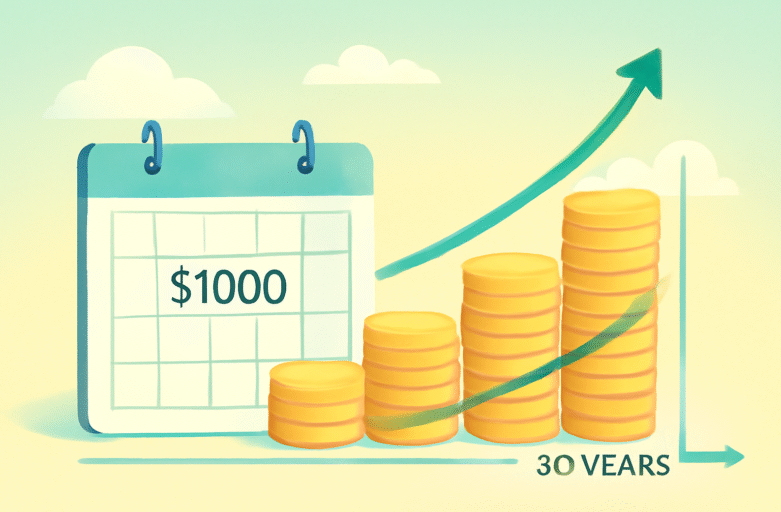

If you’re wondering how much money you could make by investing $1,000 every month for 30 years, you’re asking a smart question. Investing consistently over such a long period can build a surprisingly large nest egg. Let’s break it down in a way that’s easy to understand so you can see the potential growth of your money.
What Happens When You Invest $1,000 Every Month?
Investing $1,000 monthly is like planting seeds regularly in a garden. At first, it might not look like much. But each little bit you add grows, plus it earns returns that get reinvested month by month. This process is called “compound interest,” which means your money earns interest, and then that interest earns more interest. Over 30 years, compound interest can turn your regular $1,000 deposits into a significant sum.
You may want to know exactly how much that is. The final amount depends on the rate of return you get from your investments. Commonly, people use the stock market as an example because historically it averages around 7% annual return after inflation. Keep in mind, this is an average; some years can be higher or lower.
Let’s Do the Math: How Much Could You Have?
To find out how much your investments will grow, we use a formula to calculate the future value of monthly investments with compound interest. But don’t worry—here’s a simple way to follow along without getting buried in math.
- You invest $1,000 every month.
- The investment period is 30 years.
- Assume an average annual return of 7%, compounded monthly.
Using those numbers, you can expect your investment to grow to approximately $1.25 million. Yes, that’s over a million dollars just by putting away $1,000 a month!
Here’s a quick way to think about it: You would have contributed $360,000 (which is $1,000 x 12 months x 30 years). The rest, about $890,000, is the growth from investment returns.
What if Your Interest Rate Changes?
The 7% rate is a common guess, but what if your investments grow faster or slower? Here’s an estimate of how different annual return rates can impact your $1,000 monthly investment over 30 years:
- 5% return: around $757,000 total
- 7% return: around $1.25 million total
- 10% return: about $1.76 million total
This shows that even a small change in the return rate matters a lot over time. The higher the return, the more your investments grow.
Why Should You Keep Investing Regularly?
One key to hitting these numbers is consistency. Investing $1,000 every single month without interruption beats trying to time the market or relying on a lump sum. Regular investing takes advantage of dollar-cost averaging, which reduces the risk of buying when prices are too high.
Also, investing monthly helps you build discipline and keeps you on track to reach your financial goals. Even if the market dips, your monthly investing keeps going, so you buy more shares cheaply and set yourself up for better growth when the market rebounds.
What Types of Investments Can Help You Achieve This?
You might wonder where to put your $1,000 each month to reach that 7% or 10% return. Popular choices include:
- Stock market index funds: These track a whole market like the S&P 500, giving you broad exposure to many companies.
- Mutual funds: Managed portfolios picking stocks or bonds based on specific strategies.
- Exchange-Traded Funds (ETFs): Like mutual funds, but traded like stocks.
- Retirement accounts (401(k), IRA): These accounts offer tax benefits and are great for long-term investing.
Generally, investing in a mix of stocks and bonds based on your risk tolerance is wise. Stocks tend to give higher returns over time but are more volatile. Bonds offer stability but usually lower returns.
Will Inflation Affect Your $1.25 Million?
Good question! Inflation means the prices of everything go up over time, so your money’s buying power may shrink. While $1.25 million sounds like a lot today, in 30 years, it may not buy as much as you think.
For example, if inflation averages 3% per year, the real (inflation-adjusted) value of that $1.25 million will be roughly $470,000 in today’s dollars. This means your investment still grows, but you should plan your retirement spending accordingly.
That’s why many financial advisors suggest aiming for a mix of growth and inflation protection, like stocks and some inflation-protected bonds, to keep your money’s value intact.
What You Should Do Now
If you want a comfortable future or early retirement, consistently investing $1,000 monthly puts you on a strong path. Over 30 years, even a moderate return turns your small monthly deposit into a life-changing sum of money.
You don’t need to be a financial expert to start. Choose a simple investment plan, like low-cost index funds, and commit to investing every month. The power of compounding and regular investing will do the heavy lifting.
Remember: the sooner you start, the more time your money has to grow. Even small amounts can turn into thousands or millions over decades, just by staying patient and consistent.
So, ask yourself—what if you started today? Your future self might thank you tremendously.