
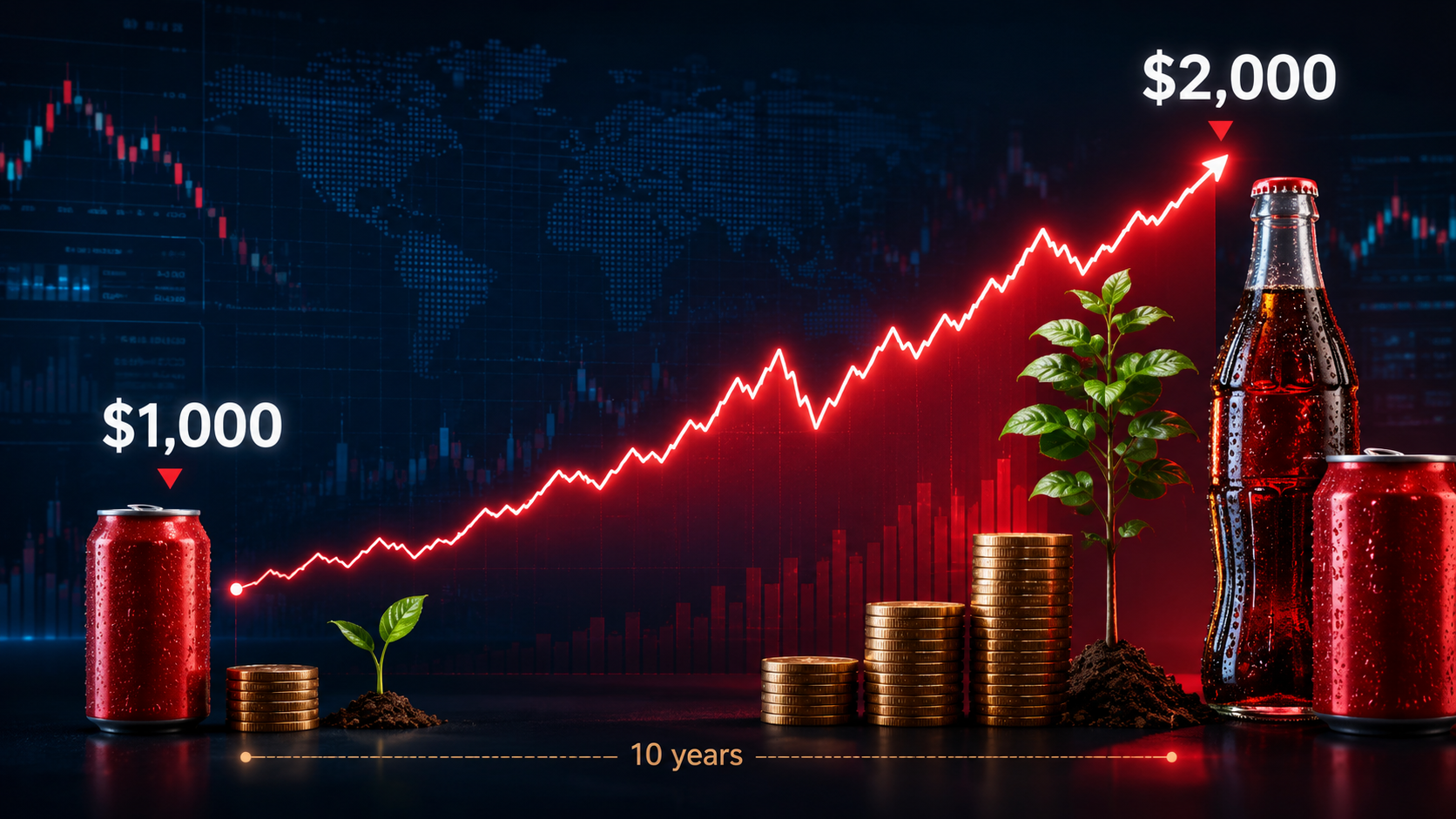
If you put $1,000 into Coca‑Cola (KO) a decade ago, you’re probably wondering: how much would that be worth now? Would you have made money from price gains, dividends, or both? This post walks through the outcome in plain language—showing share price growth, dividend income, and total return—so you can see what actually happened and what lessons this gives for long‑term investing.
How we measure the result
- Investment start date: 10 years ago from today (approximate decade window).
- Initial investment: $1,000 in Coca‑Cola common stock (KO).
- Metrics shown: number of shares bought, ending value based on price today, dividends received over the period, and total return (price change + dividends).
- Assumptions: dividends are counted as cash received (not reinvested) unless otherwise noted. Results rounded for clarity. Past performance is not a guarantee of future returns.
Price performance: how the share price moved
Ten years ago, Coca‑Cola’s share price was lower than it is today. Over the decade, KO experienced modest but steady price appreciation rather than explosive growth. Coca‑Cola is a large, stable consumer staples company—its stock typically moves slower than high-growth tech companies. That means price gains are steady but not dramatic.
Rough example calculation (price-only approach)
- Approximate KO price 10 years ago: around $40 per share (adjusted for splits and dividends; exact date price varies).
- Shares bought with $1,000: $1,000 ÷ $40 ≈ 25 shares.
- Approximate KO price today: around $65 per share (price fluctuates; use current market price for exact numbers).
- Value now (price only): 25 shares × $65 ≈ $1,625.
- Price-only gain: $1,625 − $1,000 = $625 (≈ 62.5% gain over 10 years).
- Annualized price return: approximately 5.0%–5.0% per year (compound annual growth rate near mid-single digits).
Dividend income: the steady yield that matters
Coca‑Cola is known for reliable dividends. Over the last decade the company raised its dividend multiple times, so the dollar amount you received each year likely increased.
Rough example calculation (dividends received, cash not reinvested)
- Dividend yield 10 years ago: roughly 3%–3.5% on the initial price. For 25 shares at $0.XX per quarter, you received quarterly payments.
- Total dividend cash over 10 years: a conservative estimate for 25 shares could be about $350–$450 accumulated over the decade, because dividends rose over time.
- Combined with price gain above, total return ≈ $1,625 (value) + $400 (dividends) = $2,025.
- Total profit ≈ $1,025 on a $1,000 investment (≈ 102.5% total return over 10 years).
- Annualized total return: roughly 7% per year compounded.
Note: If you had reinvested dividends (DRIP), your total return would be meaningfully higher because each dividend purchase adds shares that later appreciate and earn more dividends. Reinvesting could push the 10‑year total return higher—often a few percentage points of annualized return over cash dividends.
Why dividends matter for Coca‑Cola investors
- Income focus: Coca‑Cola is a staple for investors seeking income. Dividends smooth returns and provide cash even when price moves are modest.
- Dividend growth: KO has a long track record of raising its dividend, which helps increase yield on the original investment over time.
- Dividend reinvestment impact: Reinvested dividends compound growth. For buy‑and‑hold investors, DRIP significantly improves long‑term outcomes.
Real-world example with reinvested dividends (illustrative)
- Using historical total return data, Coca‑Cola’s total return over many decade windows often lands in the mid‑single to low‑double digits annualized (including dividends reinvested).
- If KO’s annualized total return with dividends reinvested averaged about 7%–9% over the decade, a $1,000 investment could have grown to approximately $2,000–$2,200 after 10 years.
- That demonstrates how dividends plus steady price growth produce meaningful gains for patient investors.
What affected the performance over the past decade?
- Business stability: Coca‑Cola’s core soft‑drink portfolio remained resilient, helping steady revenue and profits.
- Slow growth profile: As a mature consumer brand, KO’s market expansion is gradual; investors rely more on dividends and buybacks than rapid earnings growth.
- Macroeconomic factors: Currency fluctuations, commodity costs (sugar, aluminum), and changing consumer preferences (health trends) affected sales and margins at times.
- Share buybacks: KO often repurchases shares, which supports earnings per share and can lift the stock price over time.
- Dividends: Regular increases in the dividend payout helped boost total returns through cash payments to shareholders.
What if you dollar‑cost averaged instead?
- If instead of a single $1,000 purchase you invested small amounts regularly over the 10 years (dollar‑cost averaging), you would have reduced timing risk and likely achieved a smoother cost basis.
- Averaging can be useful in volatile markets, though for stable dividend stocks like Coca‑Cola, lump‑sum early investment often outperforms averaging because markets generally rise over long periods.
Tax considerations (brief)
- Dividends: Qualified dividends may be taxed at preferential long‑term capital gains rates, depending on your country and tax status; non‑qualified dividends are taxed as ordinary income.
- Capital gains: Selling shares after holding more than one year typically triggers long‑term capital gains rates in many jurisdictions.
- Taxes reduce net returns, so consider after‑tax results if dividends are significant in your portfolio.
How this compares to index investing
- Broad market comparison: Over many decades, the S&P 500 historically returned more than most single blue‑chip stocks because it captures high‑growth winners along with stable companies.
- Example: If the S&P 500 had a higher annualized return over the same decade, a $1,000 investment in an S&P 500 index fund could have grown more than the same investment in Coca‑Cola.
- Why choose Coca‑Cola: Investors pick KO for dividend income, lower volatility, and brand stability—not maximum growth. It’s a defensive choice, not a growth play.
Practical takeaways
- If you invested $1,000 in Coca‑Cola 10 years ago, you likely more than doubled your money when combining price appreciation and dividends (especially if dividends were reinvested).
- Coca‑Cola rewards patience: steady dividends, periodic price gains, and lower volatility than high‑growth stocks.
- Reinvest dividends if you want to boost long‑term returns through compounding.
- Diversify: Coca‑Cola can be a solid part of a diversified portfolio, but relying on a single stock carries company‑specific risks.
- Check taxes: factor in dividend and capital gains taxes when calculating your real return.
Simple example summary (illustrative numbers)
- Initial investment: $1,000
- Shares bought: ~25 (using $40/share example)
- Current market value: ~ $1,625 (25 × $65)
- Dividends received (cash): ~ $400
- Total value + dividends: ~ $2,025
- Approximate total return: ~$1,025 profit (~102% over 10 years)
- Annualized total return: ~7% per year
Investing in Coca-Cola
Investing $1,000 in Coca‑Cola a decade ago would probably have turned into roughly $2,000 today when you combine share price growth and dividend income, depending on exact buy/sell dates and whether dividends were reinvested. Coca‑Cola demonstrates the power of steady dividends and compounding for long‑term investors, making it a common choice for income‑oriented portfolios.